Monday 16 / November / 2026
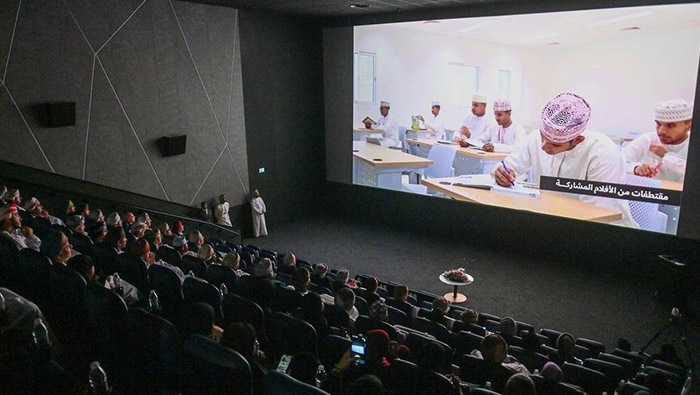
Muscat: Omani cinema is witnessing a creative dynamism driven by youthful experiments in screenwriting, directing and film production, delivering works that draw inspiration from the local environment, reflect the cultural and social contours of Omani society and offer narratives with human dimensions that transcend the boundaries of place.
On the state of Omani cinema, Issa bin Salim Al Subhi, a film director, said there are serious cinematic endeavours in the Omani film industry by young people passionate about screenwriting and cinematography. These efforts are backed by institutional support from the competent authority, which contributes to shaping societal awareness and empowering youth in filmmaking. He noted that the field relies heavily on experience and on observing the stories, tales and situations that the filmmaker or story writer lives through.
He added: "Cinema today enjoys wide reach around the world as a language understood by all. Cinematic works represent an important cornerstone in introducing and promoting Omani culture when screened at international forums and festivals. We encounter many situations worth telling in a cinematic way, and here lies the importance of observation and documentation. The more the writer or director lives the story with its emotions and details, the more truthfully and powerfully he can convey it to the audience. Reading, writing and observing what goes on around us enhance the passion for filmmaking and give the filmmaker new ideas."
He explained that many Omani cinematic works are distinguished by a special character that reflects our culture and Omani identity, pointing to his passion for making an Omani film with a local identity and a global spirit that audiences from different cultures can understand, and through which he can compete for awards at international festivals.
He noted that some filmmakers in the region are influenced by world cinema, including Hollywood and Bollywood. This may produce works that do not always reflect Arab identity. By contrast, he noted, when a foreign audience watches an Arab film bearing the features of our culture and identity, it undergoes a different experience from what it is accustomed to in world cinema, especially commercial productions.
He concluded by emphasising that contemporary cinema has become an important means of conveying ideas and cultures, and may even surpass the book in its impact, because it gives image, sound and emotion room to reach people wherever they are.
For her part, Malak Harib Al Ghafri, a film director and screenwriter, said there is a difference between a cinematic landscape that produces films and one that produces filmmakers capable of enduring. This paradox encapsulates part of the reality of the short film in the Sultanate of Oman. She noted that the success of individual experiences, however great their artistic value or presence at festivals, does not necessarily mean we have a fully-fledged film industry.
She added that through her participation in local and international festivals and competitions, she has become more aware that the true value of any cinematic movement lies not only in its immediate output, but in its ability to transform scattered experiences into a continuous creative trajectory in which expertise accumulates and through which tools and visions evolve.
She affirmed that the landscape needs not only more seasonal opportunities, but an integrated production ecosystem that begins with developing scripts and nurturing projects, passes through financing and technical training, and does not end at the premiere but extends to distribution and access to festivals and film markets.
She explained that the field needs a shift from a culture of individual achievement to a culture of institutional accumulation. This would ensure that each generation of filmmakers does not have to start from the same point or rediscover the same production challenges. The industry, she said, is not measured by the number of films we produce in a single year, but by our ability to create professional and knowledge pathways. These pathways allow a filmmaker to complete his first work, then find what enables him to make the second and the third.
She indicated that the universality of a film is not achieved by stripping it of its local specificity, but by its ability to transform that specificity into a human experience that transcends the boundaries of geography.
She added: "Through my experience in documentary filmmaking, I have realised that identity is not necessarily what we place in front of the camera, but the way we look through it. Omani specificity is broader than its heritage vocabulary. The problem begins when heritage turns from narrative material into a mere visual end, so the film becomes a display of identity instead of a rediscovery of it."
She indicated, in her estimation, that the universality of the Omani story lies not only in introducing foreign audiences to Oman, but in its ability to discover something of themselves through it.
Dalila Ali Al Durei, a director and screenwriter, said that the Omani short film has been able in recent years to take important steps in expressing society, its issues and transformations. It has gradually moved from merely documenting the local environment and highlighting its features to presenting narratives carrying deeper human dimensions. These narratives touch emotions and experiences with which people anywhere can engage.
She added that cinema in its essence is not merely a transfer of reality, but a rereading and presentation of it with an artistic vision capable of raising questions and touching the conscience. What distinguishes the Omani environment is its cultural, social and human richness, which gives filmmakers wide scope to discover stories worth telling.
She noted: "Through my experience in making short narrative films, I believe that a local story can reach universality when it possesses sincerity of expression and depth of treatment. Issues related to family, human relationships, psychological conflicts and fateful choices are not the monopoly of any particular society, but are shared human experiences."
She believes that the most important starting point for a filmmaker is belief in the story he or she wants to present. That story should stem from a sincere experience or a cause the filmmaker feels is important. This is because the audience, however different its culture and language, can sense the sincerity of emotion and the depth of human experience.
She explained that there is a set of essential elements that young filmmakers should heed. Foremost among them are the strength of the screenplay, clarity of the idea and the construction of real characters carrying convincing motives and conflicts. Attention must also be paid to the visual language that is the essence of cinematic expression. The Omani environment must not be employed merely to show beautiful locations or cultural heritage, but should be an integral part of the story, influencing characters and events and giving the film its specificity and identity.
She added that it is also important to avoid excessive explanation and direct dialogue and to give the image and the dramatic situation more room for expression, because cinema is an image that can transcend linguistic and cultural barriers. She also stressed the importance of opening up to global cinematic experiences, watching and analysing films and benefiting from criticism and different experiences.
She affirmed: "In my personal experience, I am keen that human characters be the primary driver of the story, and that events carry emotions and questions that transcend the boundaries of place, while preserving the spirit of the Omani environment and its authentic details. Universality does not begin with trying to imitate others but with our ability to present ourselves with sincerity and artistic awareness. The more authentic a story is in its roots and the more human in its content, the more capable it is of reaching the hearts of viewers around the world."




