Sunday 18 / October / 2026
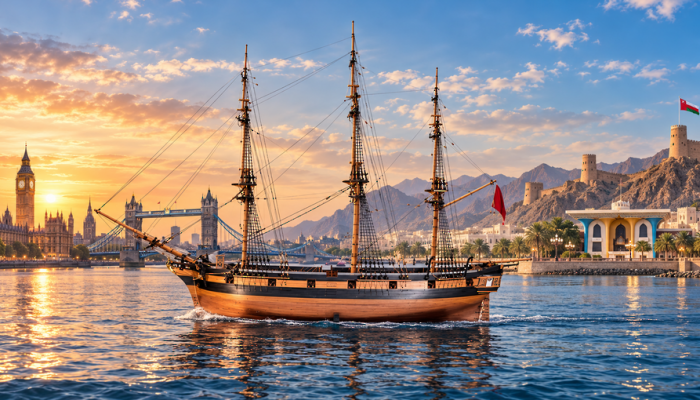
Muscat: Omani-British relations draw their historical roots from the convergence of two maritime powers in the Indian Ocean, a beginning embodied in the Treaty of 1800 that enshrined a framework of "permanent friendship" between the two countries. On 18 January of that year, Sayyid Sultan bin Ahmed and Captain John Malcolm, envoy of the British Governor-General in India, signed a supplementary agreement affirming the Treaty of 1798 and stipulating that " the friendship of the two States may remain unshook till the end of time, and till the sun and moon have finished their revolving career."
The first half of the nineteenth century is regarded as the golden age of this relationship. During the reign of Sayyid Said bin Sultan (1806–1856), the Omani fleet possessed major vessels, among them the ship "Liverpool," built in Bombay in 1826 and armed with seventy-four cannons—specifications rivalling those of the great European powers of the time. Sayyid Said later presented it to King William IV, and it was incorporated into the Royal Navy. This parity reflects the depth of Oman's maritime tradition, for the Omanis, after expelling the Portuguese from Muscat in 1650, had come to dominate the trade routes of the western Indian Ocean.
In this context, Oman News Agency (ONA) presents the views of a number of researchers and specialists in historical affairs, offering a historical narrative of the most prominent features of the friendship between the Sultanate of Oman and the United Kingdom, with a focus on how this relationship began in the nineteenth century and continues to the present day under the Renewed Renaissance of the Sultanate of Oman, led by His Majesty Sultan Haitham bin Tarik.
Dr. Nasser bin Abdullah Al Saqri, Assistant Professor of Modern and Contemporary History at Sultan Qaboos University (SQU), said that the anticipated state visit by His Majesty Sultan Haitham bin Tarik to the United Kingdom acquires exceptional historical and civilizational significance. It comes as an extension of relations whose roots reach back to the late eighteenth century, evoking a long legacy of political communication and civilizational interaction between the two countries, and carries profound symbolic meaning as the first state visit to the United Kingdom since 1982, embodying the continuity and renewal of relations across generations and eras.
He explained that Omani-British relations are read as a unique or exceptional model within the context of Britain's relations with the countries of the region—a distinction owed not merely to their antiquity, but to the historical and diplomatic characteristics that set them apart in both quantity and quality.
He added: "At a time when Britain's relations with a number of countries in the region crystallized during the twentieth century, the official roots of relations between Oman and Britain extend back to 1798, reflecting more than two centuries of continuous communication and interaction. This historical extension was not merely a chronological succession of events and interests; across multiple phases it contributed to the formation of what can be described as a historical-diplomatic balance in which mutual expertise, interests, and a level of trust and political understanding accumulated, granting this relationship a degree of particularity, flexibility, and continuity not equally available in many other regional relationships."
He indicated that the continuity of Omani-British relations across disparate historical periods is explained as the product of conscious diplomatic engineering, having succeeded in transcending historical phases marked by tensions and major events that swept the region—from the Cold War and the post-colonial era, to the emergence of oil and the transformations it wrought, to globalization and the rise of new powers, and on to the crises the region currently witnesses. At every stage, the relationship between the two countries was redefined in keeping with the context.
He pointed to several factors that contributed to the relationship's endurance across decades, foremost among them the intersection of deep interests between the two sides in security, trade, and energy; the accumulation of trust and understandings; and the strategic flexibility that made the relationship adaptable to change without rigidity or binding dependency, in addition to the human dimension embodied in deeply rooted personal and institutional ties that gave the relationship another dimension lacking in many alliances and relationships.
He noted that a clear Omani influence on British policy toward the region can be observed, as the Sultanate of Oman has remained a trusted partner, a channel of communication on sensitive files, a mediator in complex regional issues, and a source of stability in a turbulent region. Britain, in turn, benefited from Oman's geostrategic location in securing international navigation corridors, and from cultural and educational cooperation that reinforced the British presence in the region. He explained that this mutual influence reflects the nature of a relationship that has never been one-directional but rather mutually beneficial, making it a rich case study for understanding the dynamics of mutual influence in asymmetrical international relations.
He pointed out that this relationship offers an important lesson: that history, as strategic memory, helps in understanding the present and envisioning the future. Hence the value of the Omani-British experience lies not only in its longevity, but in its ability to move across different historical phases while retaining an essence of communication, dialogue, and mutual interests.
In a related context, Dr. Badriya Mohammed Al Nabhani, a researcher in history, affirmed that the nineteenth century constitutes a pivotal phase in the history of Omani-British relations, noting that she tends to read this century in three stages. She explained that the first stage began in an international context, as on 12 October 1798, the first cooperation agreement between the Sultanate of Oman and Britain was signed by Sayyid Sultan bin Ahmed and the envoy of the East India Company, Mehdi Ali Khan. On 18 January 1800, Captain John Malcolm affirmed this agreement, under which the presence of an agent of the Company in Muscat was approved.
She noted that the second stage is the era of Sayyid Said bin Sultan (1806–1856), which in her view was the most mature phase of Omani diplomacy in that century. She explained that the third stage began with the death of Sayyid Said, and noted that during the reign of Sultan Faisal bin Turki, the Treaty of Friendship, Commerce, and Navigation was signed on 19 March 1891. She explained that the milestones of cooperation between Oman and Britain can be summarized in four: first, the security of navigation in the Gulf, where Omani forces participated in the campaigns of 1809 and 1819–1820 that culminated in the General Treaty of 1820; second, cartography, where the Indian Navy conducted precise surveys of the Omani coasts in the 1830s, accompanied by travellers such as Lieutenant James Wellsted, who published his book on his travels in Oman in 1838, and these maps served commercial navigation for long decades.
Third, communications, where a telegraph station was established in 1864 on the island of Maqlab in Khasab, Musandam, as part of the line linking India to Europe. Fourth, steamships, where vessels of the British India Steam Navigation Company began calling regularly at Muscat from the 1860s, connecting it to Bombay and Basra.
She noted that under the Renewed Renaissance led by His Majesty Sultan Haitham bin Tarik, the relationship has acquired a clear economic dimension consistent with Oman Vision 2040, as the United Kingdom was in 2025 the largest foreign investor in the Sultanate of Oman, with its direct investments amounting to nearly $42 billion, an increase of 11 percent over the previous year. In January 2022, a Sovereign Investment Partnership was signed between Oman Investment Authority and the British Office for Investment, targeting clean energy and technology. On 20 May 2026, negotiations for a free trade agreement between the United Kingdom and the GCC countries, which began in June 2022, were concluded.
For her part, Dr. Bahiya Said Al Athobi, a researcher in Omani military history, explained that when speaking of Omani-British military relations, it is necessary to distinguish between the early beginnings of political and maritime relations between the two countries and the phase in which military cooperation took on a direct character in organizing forces and establishing military units.
She added that the most prominent shift in the nature of military relations began in the second decade of the twentieth century, specifically from 1913, when Oman witnessed internal political developments that necessitated a reconsideration of the organization of forces in Muscat.
She noted that British documents revealed the role played by the British Political Resident in the Gulf, Percy Cox, who in 1913 presented a conception for forming a military force in Muscat. This was followed by the Omani military statement issued by Sultan Taimur bin Faisal in 1914, and then the Political Agent and British Consul in Muscat, Robert Benn, advanced a plan for the formation of the Muscat Levy Corps, encompassing the organizational and financial aspects necessary for its establishment. She explained that these plans reveal the beginning of the transition from reliance on traditional military formations and auxiliary forces to thinking about establishing a more regular force subject to a defined military organization.
She pointed out that among the most prominent milestones worth pausing at is the Battle of Bayt Al-Falaj in 1915, which represented an early model of joint military operations between the forces of the Sultanate of Oman and British forces within the framework of the internal military conflict in Oman. She explained that the phase of establishing the Muscat Levy Corps in 1921 came to form a foundational milestone in the history of modern military organization in the Sultanate of Oman, after a series of military plans and proposals put forward during the preceding years.
She said that the relationship between the two countries was not based on entirely identical motives: Oman sought to enhance its security and stability and build forces capable of confronting internal challenges, while the British position was also linked to protecting its strategic interests in the Gulf and securing the position of Muscat.
Therefore, she believes that 1913 marked the beginning of a new phase in Omani-British military relations, while 1921 constituted an important milestone in the transformation of this relationship into institutional cooperation linked to the building of regular forces in the Sultanate of Oman.
She noted that documents relating to joint military exercises in the 1960s acquire particular importance because they provide precise details about the nature of training cooperation between the two countries. Among the important examples of this are British reports relating to the series of field exercises known as (OMEX), carried out during 1961 and 1962, in which British units participated in cooperation with units of the Sultan's Armed Forces, including the Muscat Battalion, the Northern Frontier Battalion, and the Air Force.
She explained that the role of British expertise and experience contributed to accelerating certain aspects of modernization, particularly in the fields of leadership, training, and technical specializations, but it is important to emphasize that this development came within the framework of specific Omani needs imposed by security and military circumstances, and was then reinforced by the national orientation toward building modern armed forces. She revealed that training cooperation between the two friendly countries preceded Al Saif Al Sareea "Swift Sword" maneuvers by decades, and that Omani and British forces had been conducting joint field exercises since the early 1960s. She believed that the Omani experience in military training was not merely a direct transfer of British expertise, but was based on benefiting from this expertise and re-employing it in a local environment of a different geographical and military nature, for Oman possesses diverse terrain from towering mountains to vast deserts and coastal areas, which necessitated the development of skills and training methods suited to these environments.
She noted that these maneuvers reflected an advanced level of coordination between the armed forces of the two countries, especially in the areas of operational planning, logistical support and joint command. They also highlighted the importance of benefiting from Oman's diverse geographical environment in conducting military exercises. She explained that among the important milestones that followed these maneuvers was the signing of the joint defence agreement between the Sultanate of Oman and the United Kingdom in 2019, which reinforced the institutional framework for defence cooperation between the two countries.
She added that under the Renewed Renaissance led by His Majesty Sultan Haitham bin Tarik, Omani-British military relations have continued to develop, among the most prominent manifestations of which is the joint military exercise "Khanjar Oman," which included joint field exercises aimed at developing combat and training efficiency and enhancing the ability to coordinate and carry out joint military tasks.
She concluded by affirming that the study of Omani-British military relations reveals a long historical trajectory of transformations, beginning with understandings linked to maritime security and commercial interests, then developing into direct cooperation in organizing, training, and arming military forces, and culminating in modern defence partnership. Historical documents have shown that this cooperation was not constant in its nature or objectives, but was influenced by the political and military circumstances through which Oman and the region passed, and by the strategic interests of each party.
For his part, Dr. Younis bin Jamil Al Nu’amani, a researcher in historical affairs, said that trade played a pivotal role in Omani-British rapprochement, particularly given Oman's strategic location on global trade routes, and that the economic aspect, especially commercial exchange, was the gateway to the convergence of the two countries. He added that the agreement signed by Britain with Oman in 1798 is among the most prominent and earliest agreements that paved the way for Omani-British rapprochement, as dangers were closing in on Oman both internally and externally. Sayyid Sultan bin Ahmed therefore renewed the treaty with Britain in 1800, with new clauses added, and commercial agreements between the two countries followed thereafter in what later became known as the Treaty of Friendship and Commerce.
He explained that with regard to missions and diplomatic representation, Sayyid Said bin Sultan bin Ahmed Al Busaidi signed the Treaty of Friendship and Commerce with Britain in 1839, whose third clause stipulated the exchange of consular representation between the two countries. After this treaty, Omani-British relations became alliance relations. He noted that the voyage of the Omani ship "Sultana" to London in 1842, carrying the envoy and ambassador Ali bin Nasser, is among the most important stages of diplomatic representation between Oman and Britain, as he carried with him letters and lavish gifts addressed to Queen Victoria.
He said: "The relationship between Britain and Oman can be described as one of mutual respect, for neither imposed its culture on the other; rather, each respected and came to know the other, unlike some countries that imposed their policies and culture at the same time."
He noted that there are indicators pointing to the depth of cultural relations, among them the Omani-British Friendship Association, the British Council, and partnerships between educational institutions, such as the adoption of curricula like the Cambridge curriculum, as well as the cooperation of Sultan Qaboos University with several British universities, and the scholarships offered by both countries. He noted that museums play a prominent cultural and educational role, and that there is cooperation between the National Museum of Oman and British museums (such as the British Museum and the Victoria and Albert Museum) in many respects. He believes that this civilizational acculturation is important and serves the interests of the two countries, which are bound by historical relations extending over four centuries.
Dr. Younis believes that political and economic interests were—and still are—the main driver in relations between the two countries. Accordingly, these relations must be invested in light of the existence of great opportunities for economic, cultural, and scientific exchange; other aspects must also be developed, and partnerships built in diversifying income sources, environmental protection, net zero, and benefiting from all expertise in both countries.