Saturday 18 / July / 2026
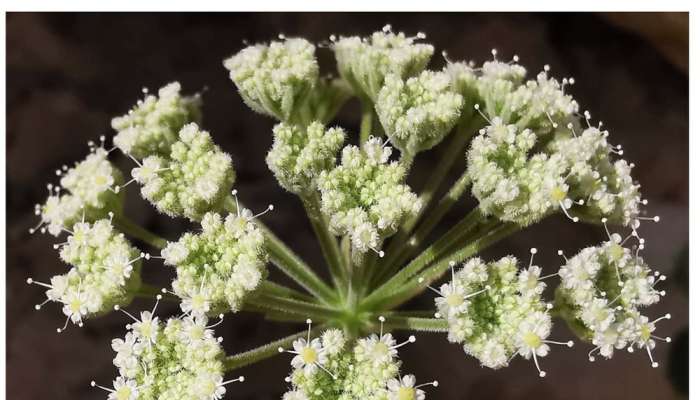
Muscat: Sultan Qaboos University (SQU), represented by the Life Sciences Unit at the College of Science, has announced the discovery of a new plant species, Adenosciadium omanensis, which had not previously been recorded in the World Flora.
The species has been named after Oman to reflect the country where it was first discovered and documented. It is native to the limestone plateaus along the coast, particularly in the eastern Hajar Mountains of northern Oman.
The newly identified species belongs to the Apiaceae (carrot) family and shares some characteristics with Adenosciadium arabicum, a related species found in southern Oman and extending into Yemen.
However, Adenosciadium omanensis differs in several morphological characteristics that evolved as a result of differences in climate and environmental terrain—factors that drive evolution and the emergence of new species.
Among the most distinctive features of the new species are its velvety-textured leaves and kidney-shaped leaflets with serrated edges.
It also produces a greater number of flowers and differs from Adenosciadium arabicum in the shape and size of its seeds.
The new species has been officially recognised internationally through its publication and formal description in the Edinburgh Journal of Botany, one of the world’s leading peer-reviewed botanical journals.
The journal is affiliated with one of the world’s foremost herbaria and is renowned for its expertise in plant taxonomy, particularly species documented from the Arabian Peninsula.
A specimen of Adenosciadium omanensis has also been preserved in the Sultan Qaboos University Herbarium, where it serves as the internationally recognised scientific reference specimen for the species.
No local name has yet been recorded for the plant, and there is currently no information on its traditional or practical uses.
Researchers say further studies are needed to investigate its chemical properties, assess its potential medicinal applications, and better understand its ecological significance.
The Arabian Peninsula is recognized as one of the world’s 34 biodiversity hotspots, particularly its southern region, which includes Oman, Saudi Arabia and Yemen.
The region’s diverse environments and landscapes have attracted botanists seeking to document its rich plant diversity. In 2020, the total number of recorded plant species in Oman was estimated at around 1,300.
SQU noted that continued taxonomic research has led to the identification of additional Omani plant species that had not previously been recorded, as well as the discovery of species new to science. As a result, the total number of recorded plant species in Oman has risen to 1,440 over the past five years.