Wednesday 15 / July / 2026
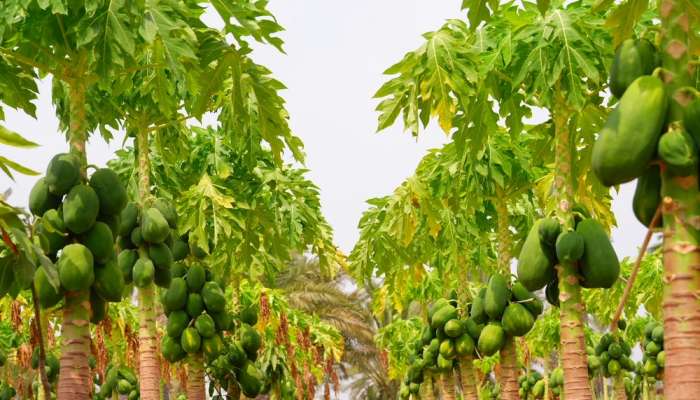
Shinas: Modern agricultural projects in the Sultanate of Oman continue to strengthen their role in supporting the national food security system through the expansion of high-yield, economically viable crops and the adoption of advanced irrigation and farm management technologies. These efforts contribute to enhancing the efficiency of natural resource utilization, increasing the supply of local produce in domestic markets, and opening new avenues for agricultural investment while adding value to the sector.
The papaya cultivation project undertaken by farmer Khalid Mohammed Al Qamshouei in the Wilayat of Shinas, North Al Batinah Governorate, stands as a promising model in this regard. Launched in 2023 across an area of approximately five acres, the project capitalizes on the productive characteristics of this crop and its suitability for the Sultanate of Oman’s climatic conditions.
Al Qamshouei stated that the decision to cultivate papaya followed a thorough assessment of the crop's attributes, notably its adaptability to local weather conditions and the fact that its potential pests are well-documented and can be effectively managed. He added that the crop's year-round production cycle and strong demand in local and regional markets were key factors encouraging its expansion.
In a statement to Oman News Agency (ONA), he noted that the project initially faced a number of challenges, including soil conditions, water management, high temperatures and humidity, as well as difficulties in sourcing high-quality seeds. However, these obstacles were overcome through the implementation of modern agricultural practices and the utilization of technical extension services.
He indicated that the farm cultivates two varieties—the Chinese "Red Lady" and the Thai variety—selected for their strong pest resistance, high yield density, relatively compact growth habit, fruit quality, and strong consumer appeal.
He explained that papaya trees begin bearing fruit approximately six months after transplanting seedlings to the permanent field, with production continuing for up to 36 months. Under optimal conditions, each tree yields between 30 and 40 kilograms of fruit.
The project employs a drip irrigation system to optimize water consumption, with trees irrigated every 36 hours for 15 minutes per cycle, following a carefully designed schedule that ensures high water-use efficiency. A regular fertilization programme is implemented through the injection of ready-formulated fertilizer blends into the irrigation network at calculated rates that meet the plant's requirements across various growth stages.
He further noted that the farm's output is marketed locally through Omani traders, with an average selling price of approximately 350 baisa per kilogram, subject to seasonal fluctuations and supply-demand dynamics. The production cost per tonne is estimated at around RO 100.
He pointed to the support provided by the Ministry of Agriculture, Fisheries and Water Resources, which has included technical extension guidance and the provision of limited quantities of fertilizers—contributing to enhanced performance and improved productivity.
Looking ahead, he confirmed that the next phase aims to expand cultivated area, alongside a strategic shift toward agro-processing and the production of value-added goods such as juices and dried products, thereby boosting economic returns and enhancing the competitiveness of Omani produce.
He offered advice to prospective investors in this sector, emphasizing the importance of scientifically preparing agricultural land and adopting modern irrigation networks and advanced fertilization systems as critical success factors for project viability and production sustainability.