Monday 06 / July / 2026
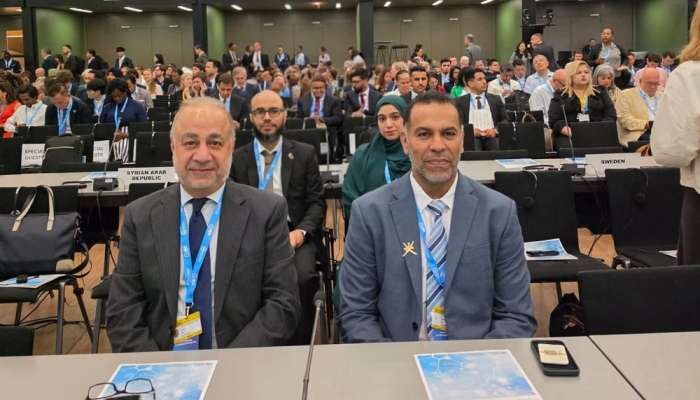
Geneva: The Sultanate of Oman today took part in the first session of the United Nations Global Dialogue on Artificial Intelligence (AI) Governance. The session, which kicked off at the Palexpo international convention centre in Geneva, Switzerland, is being attended by representatives of United Nations member states, global technology companies, civil society organizations, academic institutions and the global technical community.
Oman’s delegation to the global dialogue on AI governance is led by Dr Ali bin Amer Al Shidhani, Undersecretary of the Ministry of Transport, Communications and Information Technology for Communications and Information Technology. The delegation includes Dr. Idris Abdul Rahman Al Khanjari, Permanent Representative of the Sultanate of Oman to the United Nations and International Organizations in Geneva, as well as specialists from the Ministry of Transport, Communications and Information Technology and the Foreign Ministry.
Speaking at the opening of the session, the UN Secretary-General, António Guterres, said that this is the first time that every UN member state is given a seat at the dialogue, to help activate countries’ participation into global action aimed to make artificial intelligence safer, fairer and more accessible to all.
For her part, Annalena Baerbock, President of the United Nations General Assembly, said that global dialogue is not restricted to regulating technology, but rather to developing a common vision in which progress goes hand in hand with human dignity, fairness and sustainable development.
She pointed out that responsible and collective governance of artificial intelligence will provide new and powerful tools to benefit from the technology in the fields of healthcare, education, research, crisis management and agriculture.
Dr. Ali Al Shidhani affirmed that the Sultanate of Oman possesses enough capabilities to contribute to the global action to shape a responsible AI system within the framework of Oman Vision 2040.
He expressed the Sultanate of Oman’s readiness to join hands with the United Nations and all partners for the sake of developing a safe, reliable and sustainable artificial intelligence that realizes the prosperity and dignity of peoples.
The session highlighted many issues related to artificial intelligence, including the fact that AI capabilities are developing at a pace that exceeds the ability to measure and govern them. It was also pointed out that training in leading AI models is restricted to a limited number of actors and that AI inputs and outputs are unequal geographically and linguistically, among other issues.