Friday 25 / September / 2026
Muscat: The Oman Chamber of Commerce and Industry (OCCI) implemented the “Model Farm Management” programme in the Governorates of South Al Batinah, South Al Sharqiyah, and Dhofar. The programme aims to improve local agricultural production through the use of modern and sustainable technologies, enhance resource management efficiency by improving the use of water, energy, and fertilisers, reduce agricultural waste, and stimulate investment in sustainable agricultural projects. A total of 95 entrepreneurs in the agricultural sector and owners of model farms participated in the programme during the period from 31 May to 18 June 2026.
Nadia bint Mohammed Al Nazwaniyah, Head of Coordination and Follow-up Section at the Oman Chamber of Commerce and Industry branch in Al Dhahirah Governorate and Director of the “Model Farm Management” programme, said that the programme represents a strategic step towards strengthening the position of the agricultural sector in the Sultanate of Oman, consolidating its role as one of the drivers of economic diversification, and supporting its orientation towards sustainability and innovation. She added: “This programme has been carefully designed to combine theoretical knowledge with practical application, thereby contributing to improving local agricultural production using modern and sustainable technologies, enhancing resource management efficiency through better utilisation of water, energy, and fertilisers, reducing agricultural waste, and encouraging investment in sustainable agricultural projects.”
For his part, Humaid Al Harrasi, General Manager of Falcon Training Institute, the implementing body of the training programme, said that the programme represents a strategic initiative aimed at equipping participants with practical knowledge and applied skills in the fields of supply chains, marketing strategies, and operations management, thereby enhancing their readiness to keep pace with the requirements of modern markets. He added that developing skills and competitive capabilities has become a necessity in light of the rapid changes taking place around the world. He pointed out that these efforts are aligned with the objectives of Oman Vision 2040, which aims to build a knowledge- and innovation-based economy.
Professor Ahmed Abdel Fattah Ali Ahmed, an expert in food and agricultural industries, delivered the training programme to participants. He reviewed the perception of Omani agricultural products in different markets and analysed the strengths, available opportunities, and challenges facing the vegetable, fruit, field crop, livestock, and poultry sectors. He also focused on the concept of agricultural supply chains and their importance in improving production, marketing, and export efficiency, while presenting practical models for designing supply chains suited to the nature of various agricultural products. The training sessions also included discussions on a range of modern strategies for developing agricultural exports, including exporting raw products, adding value through food processing, building Omani brands, collective exporting through production clusters, and leveraging e-commerce platforms and direct contracting with importers in target markets.
Field Visits
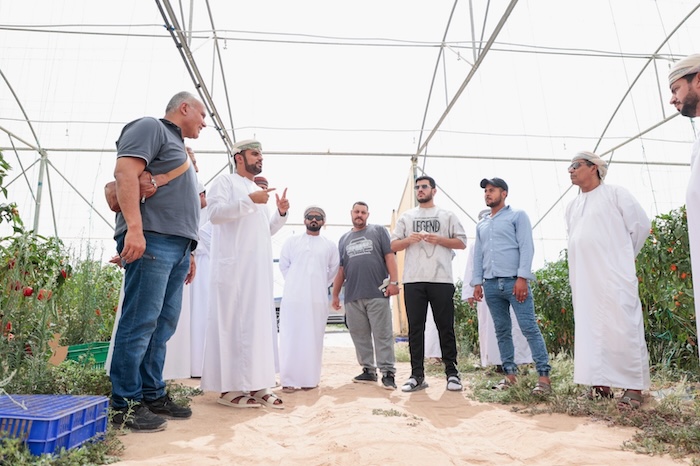
The training programme was accompanied by field visits to a number of model farms and agricultural projects in the targeted governorates, with the aim of strengthening the practical component and linking theoretical knowledge with field applications. Participants visited Al Hazm area in the Wilayat of Al Musannah in South Al Batinah Governorate, the Smart Agriculture project of the Agricultural and Fisheries Development Company in the Wilayat of Al Kamil Wal Wafi in South Al Sharqiyah Governorate, and Dhofar Foods and Investment Company in Dhofar Governorate.
During these visits, participants were introduced to best practices in farm management, mechanisms for improving agricultural production efficiency, and the use of modern technologies in irrigation and resource management. They also learned about successful experiences in agricultural marketing and supply chain development, contributing to improving farm efficiency and enhancing the sustainability of agricultural projects.
Five Specialised Training Programmes
It is worth noting that the “Model Farm Management” programme is one of five specialised training programmes launched by the Oman Chamber of Commerce and Industry, aimed at developing the skills of the private sector and enhancing its efficiency across a number of vital economic sectors, namely industry, tourism, agriculture, logistics, and mining. These programmes come within the Chamber’s strategic directions, which are based on three main pillars: improving the business environment, expanding the base of economic diversification, and partnering in the economic development of the governorates, thereby contributing to the achievement of the objectives of Oman Vision 2040.
These programmes include the Industrial Excellence and Export Programme, the Sustainable National Tourism Entrepreneurship Programme, the Model Farm Management Programme, the Logistics and Supply Chain Management Programme, and the Efficient and Sustainable Mining Project Management Programme.
The Chamber will implement the “Logistics and Supply Chain Management” training programme during the period from 28 June to 16 July, targeting company owners and employees in the trade, transport, manufacturing, warehousing, and distribution sectors. The programme will be delivered in Muscat Governorate, South Al Batinah Governorate, and Al Buraimi Governorate. It aims to improve the efficiency of supply chain management and logistics operations, reduce operating costs and increase product delivery speed, develop effective strategies for warehouse and transportation management, enhance the use of modern technologies in this field, and raise competitiveness in local and international markets.
Meanwhile, the Chamber will implement the “Effective and Sustainable Mining Project Management” training programme during the period from 26 July to 13 August, targeting project managers in mining companies, entrepreneurs, and institutions operating in the mining sector. The programme will be delivered in North Al Batinah Governorate, Al Buraimi Governorate, and Al Dhahirah Governorate. It aims to enable participants to manage operations and develop mining projects and related ventures, enhance environmental awareness and promote a culture of sustainable mining, and increase efficiency in mining operations while applying safety standards.