Saturday 30 / May / 2026
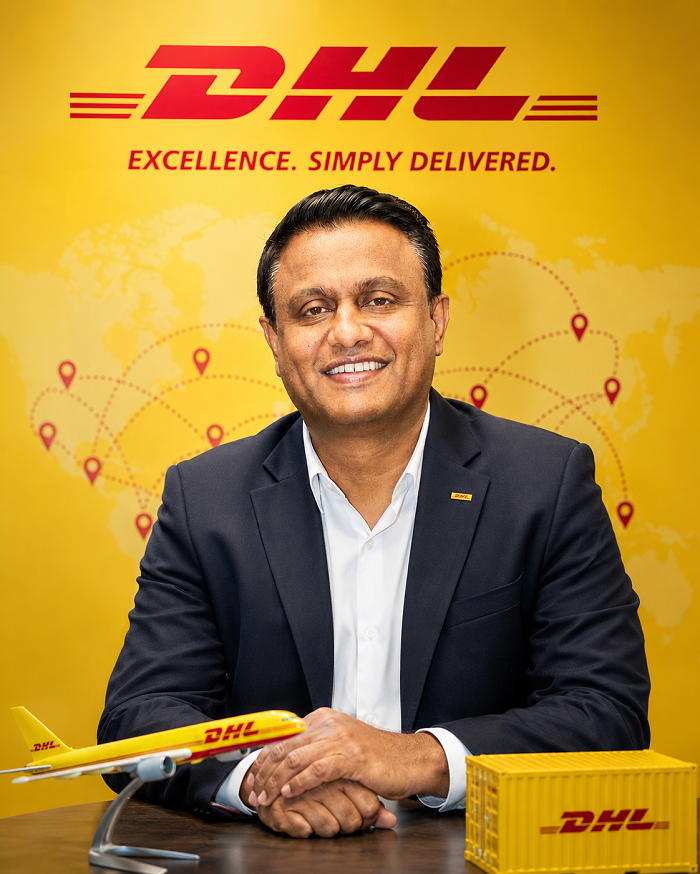
“Today, logistics is no longer just about moving shipments. It is about business continuity, confidence, and connecting economies during both normal and crisis periods,” says Roy Scaria, Country Manager of DHL Global Forwarding, Oman, reflecting on his long journey in the logistics industry.
Roy has witnessed the transformation of logistics from traditional manual operations into highly digital and globally connected supply chains.
He believes speed, communication, and adaptability have become the backbone of modern logistics. Today, the global logistics market is valued at more than USD 10 trillion, with nearly 90% of global trade volume moving through sea freight.
Speaking on the recent geopolitical tensions and the Strait of Hormuz situation, he noted that global supply chains are under increasing pressure from disruptions, rising freight costs, fuel price volatility, and longer transit times. “Now honestly, who doesn’t know the Strait of Hormuz today?” he says humorously.
“Earlier only logistics people spoke about it, but now everybody discusses it because global trade impacts everyday life.” Roy highlighted that the Strait of Hormuz alone handles around 20% of global oil and LNG trade, making the region strategically critical to the world economy.
He also emphasized Oman’s growing role as a regional logistics hub during recent crisis periods. “Oman showed the world that we are one of the best transit and logistics support countries in the region. The government simplified processes, opened green corridors with GCC countries, and supported supply chain continuity during extremely challenging times.”
According to Roy, Oman’s strategic location before the Strait of Hormuz, together with ports like Port of Sohar, Port of Salalah, and Port of Duqm, positions the country as a smart alternative logistics corridor and a reliable Plan B for the GCC region.
Roy also clarified a common market perception about DHL. “Many people still think DHL only handles air shipments, but DHL is also one of the leading players in Sea Freight globally, and in Oman we hold a major market share in sea freight as well.”
He added that during the recent disruptions Oman is increasingly positioning itself as one of the best SEA-AIR hubs in the region, with cargo moving from Asia through Oman onward to Europe, the USA, and GCC countries.
He also pointed to Oman Vision 2040 and the Sultanate’s logistics ambitions.
Currently, logistics is already one of the largest contributors to Oman’s economy after hydrocarbons, contributing around USD 2.8 billion to GDP. Under Vision 2040, the sector is expected to contribute nearly USD 36 billion to GDP while creating around 300,000 jobs in the logistics sector, positioning Oman as a major global logistics hub.
Discussing the future of logistics, Roy pointed to AI, automation, sustainability, and innovation as major industry drivers. “AI is already supporting forecasting, analytics, route optimization, reporting, and operational efficiency across the logistics industry,” he explained.
However, he believes human relationships will remain irreplaceable. “AI can support business, but in logistics we still need to visit customers, understand challenges, shake hands, and walk in with a smile.”
Roy also spoke about DHL’s Innovation Center in Dubai, where customers and businesses can experience the future of logistics and supply chain technology. The center showcases innovations around AI, robotics, automation, sustainability, smart warehouses, digital supply chains, and future transportation trends. “It is really good to see where the future is moving,” Roy said, while encouraging businesses, students, and young professionals to visit the Innovation Center to better understand how technology is transforming global logistics.
On leadership, Roy says his approach is rooted in empathy and humanity.
“Leadership is not only about targets and numbers. It is about supporting people, building trust, and standing together during difficult situations.”
Roy also had full praise for his team members during the recent crisis periods.
“All our employees worked around the clock to support our customers and regional operations during extremely challenging times. I am really thankful to this team. Behind every successful supply chain there are committed people working day and night to make things happen.”
Speaking to young professionals, Roy encouraged them not to underestimate their own potential.
“Never settle too early or limit your ambitions. Aim for leadership positions and bigger responsibilities. Look at leaders like Sundar Pichai and Satya Nadella — their journeys prove that global leadership is not defined by where you come from, but by mindset, discipline, consistency, and willingness to continuously learn.”
He added that while skills can always be developed, character and attitude remain the real differentiators.
“Discipline, ownership, consistency, and integrity are the real foundations of long-term success.”