Sunday 12 / April / 2026
Ibra: North Al Sharqiyah Governorate witnessed extensive developmental activity throughout 2025 in the agricultural, livestock, and water sectors, manifested in a package of projects and achievements implemented and supervised by the General Directorate of Agricultural Wealth and Water Resources in the governorate.
These efforts come within the strategic framework of the Ministry of Agriculture, Fisheries, and Water Resources to enhance food security, develop water resources, and support farmers and breeders in alignment with the objectives of Oman Vision 2040.
Dr. Abdulaziz Ali Al Mashikhi, Director General of Agricultural Wealth and Water Resources in North Al Sharqiyah Governorate, stated that the economic data achieved in the governorate for 2025 showed that the average total agricultural production over the past three years reached 1,267,000 tonnes.
He noted a 7 percent growth in the area used for fruit cultivation, totaling 841 acres with a total production of 4,633 tonnes. Additionally, the area of model fruit farms reached 503 acres, while the area of grape fields over the past three years reached 27 acres, and fig fields reached 66 acres. The area dedicated to vegetables accounted for 25.2 percent of the total, covering 989 acres with a total production of 51,295 tonnes.
He added that the total area of date palm crops grew by 1.3 percent to reach 8,359 acres, with an expected total production of 50,236 tonnes. He emphasised that North Al Sharqiyah Governorate ranked fifth nationally in date production with 50,236 tonnes, representing 12 percent of Oman’s total, with 1,003,072 palm trees.
Furthermore, the governorate ranked first among the governorates of Oman in the production of "Mabsali" dates (Busr), with a production of 11,620 tonnes, while the number of Mabsali palms in the governorate’s wilayats reached 136,112 trees.
Al Mashikhi explained that the Directorate intensified its efforts to support farmers and livestock breeders through technical support and specialised scientific events.
These included a scientific symposium in the Wilayat of Sinaw regarding the agricultural sector, held in conjunction with Omani Agriculture Day under the title "Heritage of the Past and Vision for the Future."
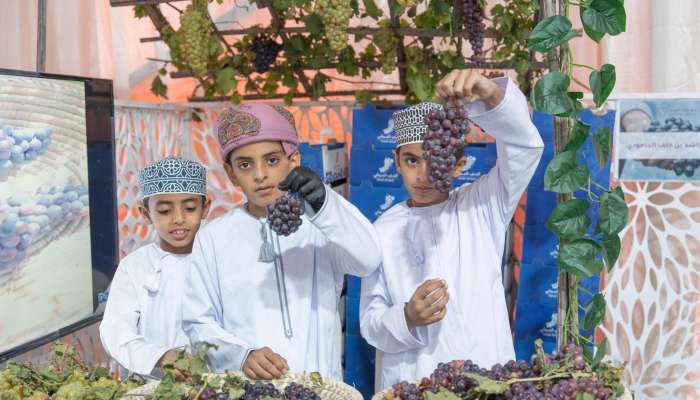
Other activities included the Grape Festival in the Wilayat of Al Mudhaibi to facilitate the marketing of grape products, and the Second Tabseel Symposium to encourage the community to preserve the Mabsali crop of dried dates (Busr), expand its cultivation, raise awareness about investment in its production, and enhance added value and downstream industries for Mabsali products.
The Director General affirmed that the governorate is witnessing rapid growth in enhancing food security and the contribution of agriculture to the national economy through farmers, the offering of investment opportunities, and the use of modern technologies and greenhouses.
The plant sector in the governorate grew by 3 percent last year, and the governorate achieved 100 percent self-sufficiency in certain agricultural and animal products, such as dates, cucumbers, honey, and eggs.
He pointed out that among the qualitative projects supervised by the Directorate is the Model Grape Farms Project in the Wilayat of Ibra, funded by the Agricultural and Fisheries Development Fund and the Oman India Fertiliser Company (OMIFCO).
This aligns with the priorities of Oman Vision 2040 regarding the private sector, investment, and international cooperation within the axes of economy, development, and environmental sustainability. This project aims to increase the value of investments in the agricultural, livestock, and water sectors in North Al Sharqiyah and raise the contribution of these sectors to the GDP at constant prices.
He mentioned that the Model Grape Farms Project contributes to strengthening the food and water security system by cultivating 100 acres of grapes, bringing the growth index of grape cultivation areas in North Al Sharqiyah to 370 percent.
This brings the total area of grape fields to 127 acres, with productivity reaching 635 tonnes and an economic return exceeding OMR1 million.
Nationally, this increases the growth index of grape cultivation areas across Oman by 50 percent, reaching a total of 300 acres. The project will also introduce six new commercial and globally competitive grape varieties: Flame Seedless, Crimson Seedless, Autumn Royal, Summer Royal, Princess, and Red Globe, which are considered a qualitative addition to local production.