Sunday 05 / April / 2026
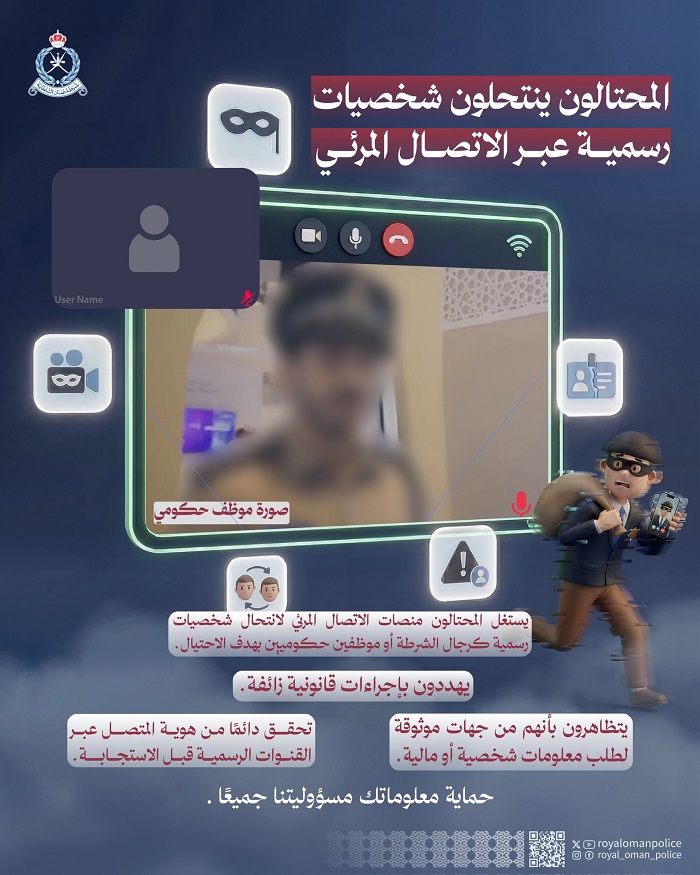
MUSCAT: The Royal Oman Police (ROP) has urged the public to remain vigilant and verify the identity of individuals claiming to represent police or government entities, following reports of sophisticated scam attempts.
“Scammers impersonate officials via video calls to deceive you. Please be cautious. Protecting your information is everyone’s responsibility,” the ROP said in an advisory issued on Sunday.
A resident of Muscat, Suhir Kumar, recently encountered such an attempt when he received a video call from a person posing as an ROP official. The caller claimed the interaction was part of an online verification process and sent a one-time password (OTP) to Kumar’s phone.
Sensing a scam, Kumar chose not to share the OTP and instead pretended he had not received it. The caller then asked for his Oman ID details, which Kumar refused to provide. The scammer became abusive before eventually disconnecting the call upon realising the attempt had failed.
Residents have reported that fraudsters often pose as representatives of trusted entities, using official logos and profile pictures of uniformed personnel to gain credibility and extract sensitive personal or financial information.
The ROP reiterated its warning, advising the public never to share personal details, bank information, or account numbers via phone calls, video calls, or social media platforms.
According to the General Directorate of Criminal Investigations, cyber fraud cases in Oman rose by 50 per cent during the first half of 2025 compared to the same period last year.
Authorities attribute this increase to rapid technological advancements, the growth of electronic payment systems, and the widespread use of digital platforms.
Officials noted that cybercriminals are becoming increasingly sophisticated, often manipulating victims’ trust and emotions to steal data and money. Among the most common scams are fake online advertisements offering products or services at unrealistically low prices. Victims are lured into paying deposits or full amounts, after which the fraudsters disappear.
Authorities have also identified emerging threats involving deepfake technologies used in video communication platforms. These techniques enable scammers to mimic real individuals, including government officials, making it harder for victims to distinguish between genuine and fraudulent interactions.
Additionally, fraudsters are creating fake websites that closely resemble official platforms and are optimised to appear at the top of search engine results. Victims are then prompted to enter personal and banking information to complete transactions.
In many cases, once victims enter their OTPs, funds are quickly withdrawn from their bank accounts. The stolen money is then moved through multiple accounts and digital currency platforms before being transferred out of Oman in a short period.
The ROP stressed that public awareness remains a key defence against such crimes and called on residents to report suspicious activity immediately.