Sunday 05 / April / 2026
A’Rustaq: Individual initiatives in the Sultanate of Oman contribute through their active presence to preserving cultural heritage and enhancing national identity. Through qualitative projects dedicated to documenting the details of ancient Omani life and passing them on to future generations, these initiatives support cultural tourism and highlight the civilizational depth of Omani society.
The Wilayat of A’Rustaq in South Al Batinah Governorate is considered one of the regions rich in civilizational and natural heritage, containing numerous tourism components. Most notable among these is Ain Al Kasfa, which is a well-known natural destination characterized by its hot springs and an environment that attracts visitors.
In this context, "Ain Al Kasfa Museum" stands out as a private heritage initiative supervised by Khalaf Harith Al Dhohli. The project was established in 2018 before its official inauguration in 2022, serving as a cultural and tourism destination that showcases the features of ancient Omani life in an integrated documentary style.
Al Dhohli stated that the idea of establishing the museum was born from a personal motivation stemming from his passion for folk heritage and his keenness to collect heritage acquisitions from various Omani environments. His goal is to preserve them from extinction and present them to generations within a knowledge-based framework that reflects the authenticity of Omani society, with a particular focus on documenting the history of the Wilayat of A’Rustaq, the scholars who contributed to its renaissance, and the ancient quarters and their deep historical and social significance.
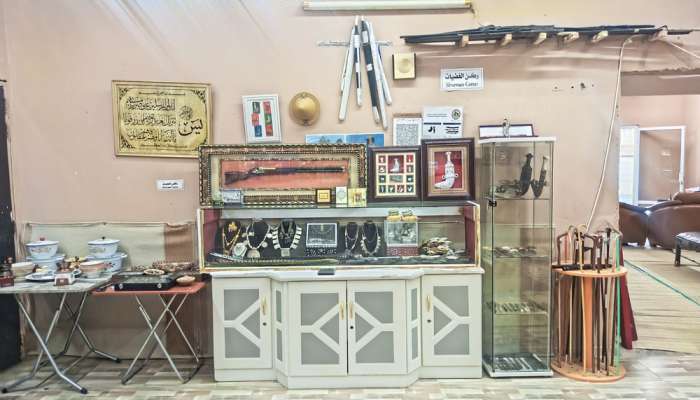
The museum houses approximately 3,000 diverse pieces, including heritage and archaeological acquisitions and tools reflecting daily details of the past. These include traditional weapons such as swords and spears, alongside Omani daggers (Khanjars), hand-worked silver, and coins documenting the history of monetary transactions. Among the most prominent and oldest exhibits in the museum is a coin dating back to the reign of Sultan Barghash bin Said in Zanzibar, representing a significant historical value that documents an important stage of Omani history linked to East Africa.
The museum contains multiple specialized sections, including the Omani palm-leaf crafts section, the Omani and international coins section, the old clocks section, and the traditional medicine and Omani pharmacy section. It also features sections for silver and copperware, and an antiques section containing old devices such as recorders, radios, gramophones, cameras, and telephones.
Furthermore, the museum includes a heritage studio section, an audio-visual library, an Omani Bedouin environment section, and a rocks and stones section, in addition to a specialized library named "Ain Al Kasfa Museum Library" dedicated to heritage and historical references. It also features introductory corners for several institutions, including the Ministry of Endowments and Religious Affairs and the Ministry of Heritage and Tourism.
The role of the museum is not limited to displaying acquisitions but extends to educational and cultural aspects. It organizes national events, such as National Day celebrations, and provides supplementary lessons for General Education Diploma students as part of its community and educational responsibility.
Annually, the museum receives approximately 3,400 visitors from within and outside the Sultanate of Oman. The project has also contributed to providing a direct job opportunity, employing an Omani staff member who welcomes visitors and introduces them to the museum's contents, reflecting the social dimension of the initiative and its role in supporting national cadres.
Ain Al Kasfa Museum is a department of the "Integrated Tourism Foundation" in the Wilayat of A’Rustaq, which aims to organize tourism tours in the wilayat and highlight its natural and historical components, thereby enhancing A’Rustaq’s presence as an integrated tourism destination.
The museum represents a successful model for individual projects that combine a passion for heritage with an awareness of its importance, contributing to the preservation of communal memory and the enhancement of national identity, while stimulating tourism in the Wilayat of A’Rustaq and solidifying its position as a distinguished cultural destination in the Sultanate of Oman.