Saturday 05 / September / 2026
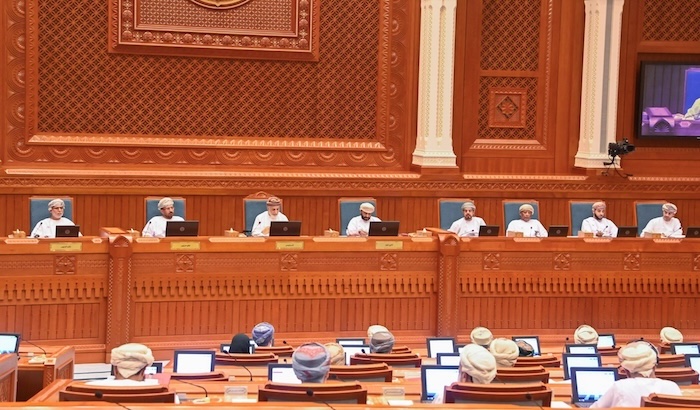
Muscat: The State Council, in its seventh session of the third ordinary session of the eighth term, discussed several draft laws referred by the esteemed Council of Ministers, including the "Draft Law on Combating Narcotics and Psychotropic Substances," pursuant to Article (50) of the Law of the Council of Oman.
The session was chaired by His Excellency Sheikh Abdulmalik bin Abdullah Al Khalili, Chairman of the State Council.
The Council also discussed the "Draft Law Amending Certain Provisions of the Personal Data Protection Law," the "Draft Law Amending Certain Provisions of the Penal Code," and the "Draft Unified Law (System) for International Land Transport between the Gulf Cooperation Council (GCC) States," pursuant to Article (49) of the Law of the Council of Oman.
The amendment to the "Draft Law on Combating Narcotics and Psychotropic Substances" comes in implementation of the objectives of the National Strategy for Combating Narcotics and Psychotropic Substances, aiming to achieve the necessary deterrence and keep pace with developments in the field of dealing with narcotics and psychotropic substances.
The draft amendment to certain provisions of the Penal Code comes as a continuation of the Sultanate of Oman's efforts to implement the requirements of the United Nations Convention against Corruption, and to strengthen efforts to improve Oman's ranking in the Corruption Perceptions Index. It also aims to achieve integration within the state's anti-corruption system, enhance corporate governance in the private sector, fulfill international obligations, and protect economic interests.
The draft amendment to certain provisions of the Personal Data Protection Law includes a definition of automated processing and specifies the scope of the law, stipulating that its provisions apply to the processing of personal data of natural persons in the Sultanate of Oman, whether the processing takes place within or outside the Sultanate. It also obligates the data controller and processor to delete personal data after the purpose of processing has been fulfilled. Personal data may be retained after the purpose of processing has been fulfilled in the event of a dispute between the data controller and the data subject, or to fulfill a legal obligation imposed on the data controller under any law, ruling, order, or judicial decision.