Wednesday 11 / February / 2026
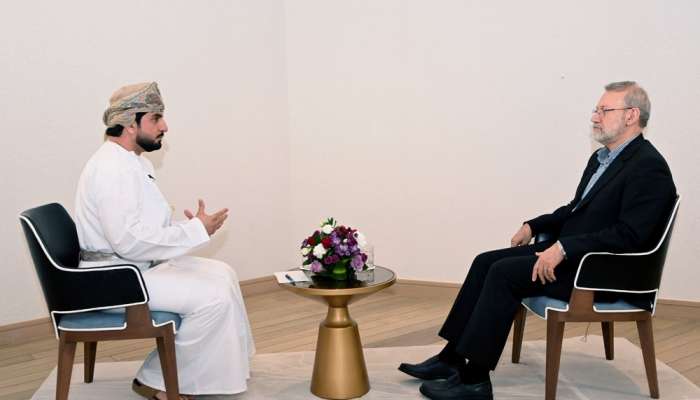
Muscat: Dr. Ali Larijani, Secretary of the Supreme National Security Council of the Islamic Republic of Iran, emphasized the profound depth of bilateral relations between the Sultanate of Oman and Iran. He noted these ties are founded on a shared history and close bonds, and are advancing effectively to serve mutual interests.
In an exclusive interview with Oman TV, he stated that his meeting in Muscat on Tuesday with His Majesty the Sultan underscores a shared, clear vision for elevating bilateral relations. The discussion also covered the state of friendly relations at regional and international levels. Dr. Larijani highlighted his meetings with several Omani officials to review common issues, shared dossiers, and mutual interests from both perspectives, aligning with the broader interests of the region.
He affirmed the vital role of the Sultanate of Oman in fostering suitable conditions for dialogue between Iran and the United States, describing it as "highly positive." He attributed this to Oman's precise understanding of regional interests, its knowledge of previous negotiation tracks and its forward-looking vision, which enables it to play a constructive and effective mediating role.
Regarding the Iranian-US negotiation round hosted by Muscat and monitored internationally, he explained that the negotiation process in the previous phase had seen gradual progress. He affirmed Iran's readiness to engage in talks whenever they are realistic, noting that Iran's stance in the first round was positive. He suggested the next phase could offer opportunities for strategic de-escalation or, at a minimum, a political repositioning, depending on the dialogue's outcomes.
On whether these talks signify a genuine shift in managing the Tehran-Washington dispute or merely constitute crisis management, he pointed to numerous claims raised by the American side. He indicated that success in the nuclear negotiations could pave the way for expanding discussions to other areas, though he cautioned it is premature to assume other disputes will be addressed at this stage.
Dr. Larijani stressed that Iran has consistently viewed war as no solution to bilateral disagreements and that regional disputes should be settled through dialogue. He stated that reliance on force by some parties has been a mistake, complicating negotiations and creating obstacles.
Concerning the potential for these talks to define the future Iran-US relationship, he deemed it too early to tell, explaining that developments are still in an early phase and that the coming stage will set the overall direction.
He noted the success of negotiations hinges on genuine political will from both sides. Adherence to a reasonable, realistic framework would lead to success, whereas introducing additional demands would result in failure. If the US aim is to prevent Iran from acquiring nuclear weapons, he asserted this goal is achievable, but linking it to other issues would complicate the process.
On the timeframe, he clarified there is no fixed schedule. Iran seeks clear solutions without delay, and the issues at hand are resolvable without protracted talks, provided there is seriousness.
Regarding prospects for success, Dr. Larijani avoided speculating on political variables but affirmed that if both sides honor their stated positions, a solution remains possible. He simultaneously highlighted the pivotal and essential role of Oman in facilitating these negotiations.
On whether the talks can be separated from regional political and military developments, he affirmed that existing regional disputes are a primary source of tension. Addressing them would help restore regional stability and peace, whereas military interventions and heightened tensions only complicate the landscape and hinder development.
In assessing current US policy toward Iran, he observed that Washington's traditional approach has grown more realistic. Previously, the US linked the nuclear file to military and missile issues, whereas the focus is now predominantly on the nuclear file—a rational approach, in his view. He reiterated that military matters are separate from the nuclear issue, and resolving the nuclear file is a crucial foundational step.
Dr. Larijani noted that while some states still struggle to comprehend current tensions, many differences can be resolved through dialogue. He added, "In this context, I believe Israel plays a prominent role in inflaming tensions and creating crises in the region," citing Netanyahu's recent statements in the US about Iran's nuclear program and imposed deadlines as potentially creating further complications.
On the main obstacles to building sustainable trust, he identified US allegations about Iran's nuclear ambitions as the fundamental hurdle. Iran, he stressed, clearly declares it does not seek nuclear weapons, and the US could take reciprocal steps to address outstanding concerns.
He noted that regional states have reached an advanced level in addressing their issues peacefully, preventing escalation—a development he described as critically important.
On the role regional and international actors can play in reducing tensions, he affirmed that most regional countries genuinely seek calm and stability. However, some show little real desire to end existing tensions. He called on regional states to recognize this dynamic to pave the way for reconciliation and the desired tranquility.
The Secretary of Iran's Supreme National Security Council, concluded his remarks by affirming that the Sultanate of Oman and the nations of the region possess formidable foundations for progress. They are endowed with abundant resources and diverse capabilities, and are home to peoples with great potential for integration. The prudent harnessing of these energies and the strengthening of regional cooperation are vital to steering the region toward genuine development and expansive advancement in the period ahead.