Tuesday 10 / February / 2026
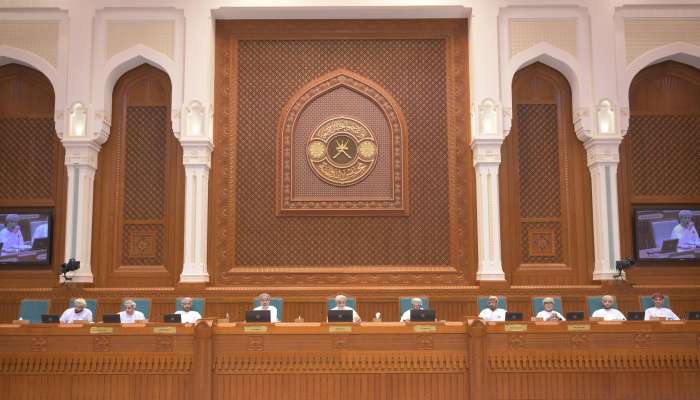
Muscat: The State Council and Shura Council held on Tuesday the first joint session of the third sitting of the eighth term of the Council of Oman, chaired by Sheikh Abdulmalik Abdullah Al Khalili, Chairman of the State Council.
The joint session involved discussing and voting on the articles of disagreement between the two councils in 7 draft laws. These include draft laws concerning the Real Estate Register, Civil Society Institutions, Combating Information Technology Crimes, Amending Some Provisions of the Cultural Heritage Law, Sports Entities, Amending Some Provisions of the Arbitration Law in Civil and Commercial Disputes, and National Geospatial Data and Information.
In a speech, Sheikh Abdulmalik Abdullah Al Khalili, Chairman of the State Council, stated that the convening of the joint session comes in implementation of the provisions of Article (49) of the Council of Oman Law, which affirms the importance of consolidating the principle of coordination and integration between the two councils by holding joint sessions in case of disagreement and divergence of opinion on draft laws referred by the government, in order to produce a unified, consolidated vision that embodies joint work.
He also emphasised, within the same framework, the harmony of work between the two councils and the Council of Ministers in serving the public interest, fostering constructive cooperation, and advancing the comprehensive development march under the wise leadership of His Majesty Sultan Haitham bin Tarik.
He added that the State Council and Shura Council had previously discussed a number of draft laws, including: the draft Real Estate Register Law, the draft Civil Society Institutions Law, the draft law amending some provisions of the Arbitration Law in Civil and Commercial Disputes, the draft Combating Information Technology Crimes Law, the draft law amending some provisions of the Cultural Heritage Law, the draft National Geospatial Data and Information Law, in addition to the draft Sports Entities Law.
Al Khalili noted that the deliberations of the two councils led to consensus on a large number of articles in those draft laws, alongside divergence on some articles. The two councils formed joint committees comprising a number of members to discuss the points of disagreement between the councils. These committees reached agreement on all those articles.
He explained that the work of Tuesday's joint session includes discussing the reports of the joint committees regarding the aforementioned draft laws, in accordance with the rules and procedures for holding joint sessions between the State Council and Shura Council.
For his part, Dr. Mohammed Said Al Hajri, Member of the State Council and Member of the Social and Cultural Committee, clarified that the joint session discussed a number of articles of divergence and disagreement regarding several draft laws and legislative amendments. Among these is the draft Civil Society Institutions Law, which aims for a legislative treatment to be more comprehensive by including a group of institutions for which regulations were issued, specifically by merging them into one law encompassing all civil society institutions.
In a statement to Oman News Agency, he explained that this comprehensive legislative treatment empowers all civil society institutions, along with addressing funding and sustainability. He indicated that with this, the draft law has become clearer and more detailed regarding the investment of these institutions' funds, which will positively reflect on the activities and programs they provide.
Regarding the draft law amending some provisions of the Cultural Heritage Law, he clarified that the legislative amendment in the law aligned with the sectoral separation between tangible heritage, which the Ministry of Heritage and Tourism is now responsible for, and intangible heritage, which the Ministry of Culture, Sports, and Youth is now responsible for. He affirmed that this separation will be reflected in the draft law.
He added that there is an important legislative separation, which is an addition to the draft law, related to geological heritage. He expressed his hope that Tuesday's session would move to approve what the joint committees between the two councils proposed regarding the articles of divergence and disagreement in the draft laws.
For his part, Younis Ali Al Mandhari, Member of the Shura Council and Chairman of the Youth and Human Resources Committee, stated that the Council began studying the draft Sports Entities Law last May and hosted all parties related to the draft law through the competent committee. All parties related to the draft law were hosted, whether from the Ministry of Culture, Sports and Youth, as well as sports clubs and federations, to take their opinions on the articles of the law, which comprised 69 articles. He indicated that the Council amended some articles and added 3 new articles.
In a statement to Oman News Agency, he added that the draft law included divergence on some articles, including 4 articles present in the draft law and articles added by the Shura Council. He noted that through the joint committee between the two councils, agreement was reached on all articles, and during the joint session, the draft Sports Entities Law was approved.
He affirmed that the draft law is a significant addition to the sports aspect, whether for federations, clubs, or committees. He expressed his hope that Omani sports would be elevated, both in terms of its practice and investment in this sector through private sector sponsorship of existing sports entities.
The joint committee between the State Council and Shura Council stated that the "draft Real Estate Register Law" aims to enhance legal protection for owners and beneficiaries, regulate registration procedures and real estate transactions, and enable digital documentation in line with the national direction towards digital transformation.
It reported that the "draft Civil Society Institutions Law" comes within the framework of the Sultanate of Oman's endeavor to enhance the environment for civil work, regulate the establishment of associations and their funding mechanisms, enabling them to perform their developmental and societal role efficiently, and achieve integration between civil society institutions and state institutions.
Meanwhile, the draft law amending some provisions of the Arbitration Law in Civil and Commercial Disputes (issued by Royal Decree No. 47/97)" sought to enhance the effectiveness of arbitration procedures to achieve speed and justice, in addition to supporting Oman's efforts in adopting best international practices in dispute settlement.
The "draft Combating Information Technology Crimes Law" aimed to enhance protection from cybercrimes, deter attacks on information systems and data, and criminalise defamation, extortion, and electronic fraud. As for the "draft law amending some provisions of the Cultural Heritage Law," it will work to enhance the protection and management of archaeological and heritage sites according to advanced standards and activate the role of the community and private sector in preserving heritage through sustainable development projects, in line with the priorities of Oman Vision 2040.
The committee affirmed that the "draft National Geospatial Data and Information Law" aims to regulate the collection, production, and circulation of spatial data to serve sustainable development planning. Meanwhile, the "draft Sports Entities Law" seeks to establish an organised and balanced legislative framework that provides an attractive and stimulating sports environment for discovering and nurturing national talents, building a solid sports foundation that supports local and international sports presence, and contributes to achieving the societal and economic dimensions of sustainable development.
The session was attended by Khalid Hilal Al Maawali, Chairman of the Shura Council, the members of the State Council and the Shura Council, and the Secretaries-General of both councils.