Sunday 26 / April / 2026
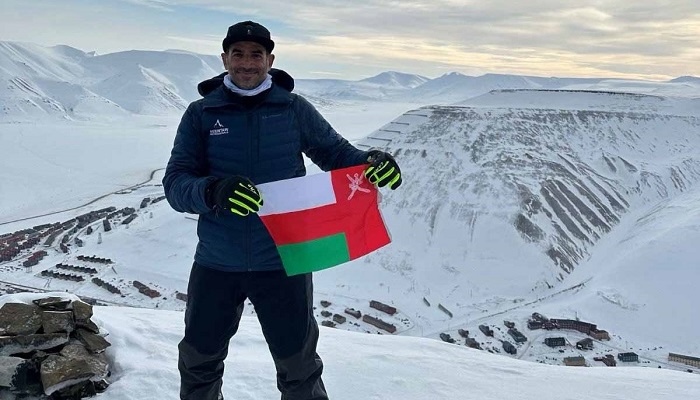
Muscat: Driven by an early passion for nature, sports, and mountains, Omani adventurer Sulaiman bin Hamoud Al-Naabi has forged a distinguished career in high-altitude mountaineering, achieving historic milestones by raising the flag of the Sultanate of Oman on the world’s highest peaks. His accomplishments include summiting Mount Everest as the first Omani and second Arab to do so, as well as completing the prestigious Seven Summits Program.
In an interview with the Oman News Agency (ONA), Al-Naabi recounted the beginnings of his journey. In 2015, he joined an official educational expedition to climb Mount Kilimanjaro without prior knowledge of the Seven Summits challenge. After successfully reaching the summit, he learned about the program from the expedition leader—an encounter he described as a turning point that marked the start of his professional mountaineering career.
He explained that the transition from hobby to professionalism followed the realization that his passion could evolve into a structured career. This prompted disciplined planning, accredited training, and a cumulative approach grounded in safety, risk management, and physical and mental preparedness. Professionalism, he emphasized, was not an instant decision but a gradual process requiring sustained commitment to international standards befitting Oman’s global representation.
The Seven Summits and Beyond
Al-Naabi noted that the Seven Summits challenge—climbing the highest peak on each of the world’s seven continents—is among the most demanding endeavors in mountaineering due to its physical, psychological, and logistical requirements. When combined with reaching both the North and South Poles, the achievement forms the Grand Slam Explorer, one of the rarest and most dangerous exploration programs worldwide, completed by only a select few.
His professional journey began on September 30, 2015, with the ascent of Mount Kilimanjaro in Africa. On December 19, 2016, he summited Aconcagua in South America, becoming the first Omani to stand atop the second-highest mountain in the world. He went on to climb Mount Elbrus in Europe on July 23, 2018, and officially completed the Seven Summits Program under a New Zealand-accredited framework on September 3, 2018.
Further milestones followed: Mount Kosciuszko in Australia on February 16, 2019; Denali in Alaska on June 20, 2019, making him the first Omani to reach North America’s highest peak; and Mont Blanc in France on August 25, 2019, as preparation for greater challenges ahead.
Everest and the Polar Expeditions
Al-Naabi described 2022 as a defining year. On May 1, he climbed Lobuche Peak in preparation for Everest, before realizing his lifelong dream on May 12 by summiting Mount Everest, the world’s highest mountain. Less than 24 hours later, he also reached the summit of Lhotse, the world’s fourth-highest peak.
On December 16, 2022, he climbed Mount Vinson in Antarctica, followed by a successful journey to the South Pole on December 24. He continued his polar expeditions on April 23, 2023, summiting the highest mountain in the Svalbard archipelago in the Arctic. His historic journey concluded on February 28, 2025, with the ascent of Carstensz Pyramid in Oceania, making him the first Omani to complete the Seven Summits and reach both the North and South Poles.
Challenges and National Impact
Al-Naabi said the challenges were as much mental as physical, citing extreme cold reaching –60°C, violent winds, avalanche risks, oxygen deprivation at high altitudes, and technical rope climbing on vertical terrain. Psychologically, prolonged isolation, lengthy expeditions, and witnessing fatal accidents along climbing routes were among the most difficult experiences.
He also highlighted professional and financial challenges. Early in his career, he worked as a physics teacher at the Ministry of Education, balancing his job with frequent international expeditions. His later transfer to the Ministry of Culture, Sports and Youth enabled him to pursue the program professionally. He underscored that the ministry’s support extended beyond funding, reflecting a broader vision to empower Omani youth and strengthen Oman’s international presence.
Logistical hurdles—travel across continents and adapting to varied climates, systems, and time zones—were overcome, he said, through faith, meticulous planning, discipline, teamwork, and responsible decision-making.
A Lasting Community Impact
Al-Naabi emphasized that his journey has grown into a sustainable societal contribution through his membership in the National Youth Committee, leadership of the “Young Traveler” initiative to train youth and promote safe adventure culture, and his role in advancing adventure sports via the Omani Adventures Committee. He also delivers awareness lectures focused on safety in natural environments.
He concluded by noting that receiving the Royal Commendation Medal holds deep personal and national significance, describing it as both an honor and a responsibility—one that motivates him to transform personal achievement into lasting value for Omani youth, enhance Oman’s presence on the international stage, and link individual success with institutional national development.