Wednesday 28 / October / 2026
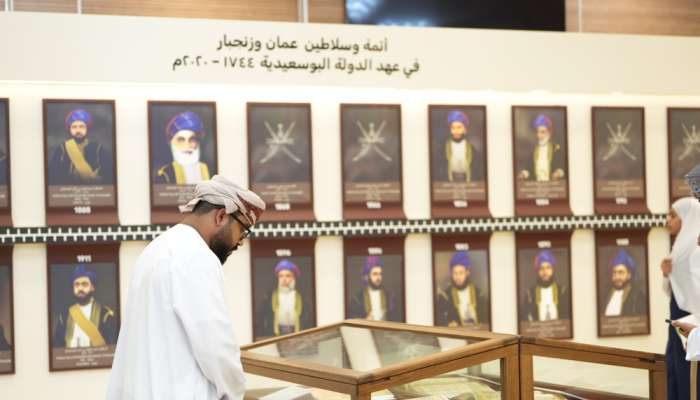
A’Rustaq: The documentary exhibition held in conjunction with the symposium "South Al Batinah Governorate in the Memory of Omani History" highlights Omani history and the cultural and civilizational legacy of South Al Batinah Governorate by displaying more than two thousand historical documents and items that document multiple aspects of the Sultanate of Oman's journey across various eras.
The exhibition, which continues through 30 October and is organized by the National Records and Archives Authority (NRAA) in cooperation with the Office of the Governor of South Al Batinah, features 11 documentary, informational, and interactive corners presenting a diverse collection of documents, correspondence, photographs, maps, speeches, manuscripts, and drawings, alongside newspapers, magazines, historical publications, collectibles, and ancient preservation and archiving tools.
The exhibition corners encompass several themes, including: the history of South Al Batinah Governorate through historical documents, the Sultans of Oman and Zanzibar during the Al Busaidi dynasty, private documents and international relations, manuscripts, and the history of documentation and archiving. This allows visitors to view historical evidence reflecting the political, social, economic, and religious dimensions of life in Oman, as well as the extent of its relations with other countries and peoples.
Dr. Hanan Mahmoud Ahmed, Director of the Documentary Exhibitions Department at the National Records and Archives Authority, stated that the exhibition comes within the framework of the authority's efforts to document the history of Omani governorates and cities and highlight their rich historical and civilizational heritage. She noted that the annual exhibition is held in one of the governorates of the Sultanate of Oman, alongside mobile documentary exhibitions organized throughout the year according to programs supporting the authority's vision and objectives in preserving national memory and making it accessible to society.
Dr. Hanan mentioned that the exhibition aims to enhance awareness of Omani history, consolidate national identity among generations, and encourage researchers and interested parties to utilize documents and archives as essential sources for studying history. It also encourages holders of private documents to register them with the authority, thereby contributing to preserving the history of families, tribes, and social life in various wilayats across the Sultanate of Oman.
She pointed out that the exhibition employs modern display methods and digital and interactive technologies to present historical content in a manner combining knowledge and experience through digital content, artificial intelligence technologies, virtual reality, video films, and audio presentations, in addition to designating platforms for children and persons with disabilities, and organizing accompanying cultural activities and competitions that contribute to broadening the scope of benefit from its contents.
The exhibition comes as an extension of the themes of the historical symposium—which continues its sessions until 28 October—by offering a reading of documents and archives as tangible evidence of the development of life in South Al Batinah Governorate, highlighting their role in preserving historical memory, transferring knowledge to future generations, and fostering community interest in documents as an integral part of cultural and national identity.
Since its opening, the exhibition has received nearly two thousand visitors, including interested individuals, researchers, and community members, to view historical documents and archives, discover the rich civilizational and cultural legacy of South Al Batinah Governorate, and learn about the authority's efforts in preserving, restoring, and making historical documents accessible to future generations.
The exhibition welcomes visitors daily from 8:30 a.m. to 6:00 p.m., providing an educational space that enables the public, researchers, and interested individuals to examine models of historical documents and learn about efforts toward their preservation and documentation.