Thursday 22 / October / 2026
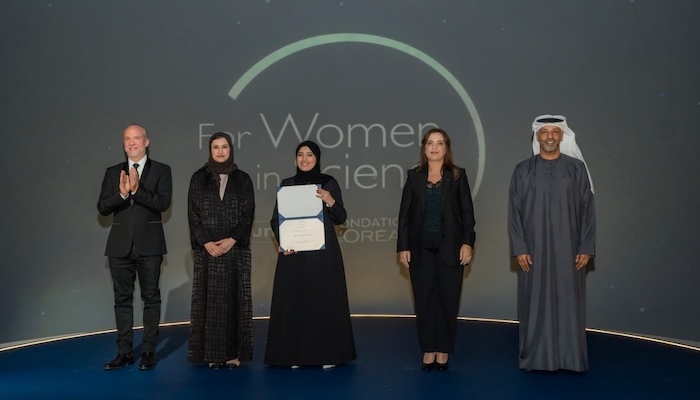
Dubai — Dr. Sarah Hamad Al Araimi, an Omani researcher and academic at the University of Technology and Applied Sciences, achieved a distinguished scientific milestone by winning the L'Oréal-UNESCO Young Talents Middle East Award for 2026 in the post-doctoral research category. This comes in appreciation of her innovative research in the field of environmental biotechnology and the development of sustainable solutions to transform waste into valuable resources.
This recognition was awarded for her research project about the topic of "Transforming Waste into Useful and Sustainable Resources," which focuses on developing innovative bioelectrochemical systems that combine bacteria and microalgae. The project aims to treat wastewater, utilize carbon dioxide, and produce value-added bioproducts, thereby contributing to addressing environmental challenges and enhancing resource investment efficiency.
This research reflects a scientific orientation toward employing modern biotechnologies to develop innovative environmental solutions that support the principles of the circular bioeconomy and contribute to transforming waste from environmental challenges into opportunities for sustainable utilization.
Dr. Sarah Hamad Al Araimi stated to Oman News Agency (ONA): "Winning the L'Oréal-UNESCO Young Talents Middle East Award for 2026 represents an important milestone in my scientific career, and a source of pride on both the personal and academic levels. On a personal level, I consider this honoring as an appreciation for years of research work, perseverance, and passion for science, and a motive to continue making scientific contributions with a tangible impact. On the academic level, it represents international recognition of the value of the scientific research I am working on, opening broader horizons for research cooperation, exchanging expertise, and developing innovative scientific solutions that contribute to addressing contemporary challenges."
She added that on the national level, she is proud that this achievement is associated with the name of the Sultanate of Oman, adding to the record of achievements realized by Omani research competencies in regional and international scientific forums. This reflects the country's abundant scientific and research capabilities, and its continuous attention to scientific research and innovation.
She expressed her thanks to Oman National Commission for Education, Culture and Science, and the important role it plays in supporting the Omani presence in international scientific initiatives and programs, and in enhancing opportunities for the participation of national competencies in regional and global forums.
She also expressed her pride in the University of Technology and Applied Sciences, valuing the academic and research environment it provides that stimulates creativity and innovation, as well as the attention it pays to developing research capabilities and encouraging researchers to excel and contribute to the production and application of knowledge.
She affirmed her hope that this honoring will serve as a catalyst to continue her research journey and contribute to achieving the Sultanate of Oman's aspirations toward a knowledge- and innovation-based economy, in alignment with the targets of "Oman Vision 2040". She also hopes it will serve as a source of inspiration for Omani girls and young women to pursue their scientific ambitions with confidence and determination.
She pointed out that the importance of this project lies in the possibility of developing innovative and sustainable solutions for wastewater treatment in the Sultanate of Oman, by transforming it from waste requiring treatment into a source that can be utilized to produce resources of environmental and economic value.
She stated that the project relies on developing an integrated bioelectrochemical system combining bacteria and microalgae. The bacteria break down organic pollutants, while the algae utilize nutrients and carbon dioxide to produce biomass that can be employed in producing value-added materials, simultaneously generating an electrical current during the treatment process.
She clarified that the applied value of this technology lies in the possibility of integrating wastewater treatment with resource recovery and energy production within a single system. This contributes to raising resource utilization efficiency and reducing the environmental impact of treatment processes. The project opens horizons for utilizing its outputs in the water, environment, and industry sectors in the Sultanate of Oman, in line with the principles of the circular economy and the targets of "Oman Vision 2040" regarding environmental sustainability and economic diversification.
Regarding future plans, Dr. Sarah Hamad Al Araimi affirmed her ambition to develop this technology and transition it gradually from the laboratory stage to industrial application. This would be achieved by raising water treatment efficiency, improving biomass production, and increasing the generated electrical energy, leading up to studying the feasibility of utilizing this energy to operate the system itself and reduce its reliance on external power sources.
She expressed her aspiration to build research and industrial partnerships with authorities concerned with water treatment in the Sultanate of Oman to develop a pilot model, test its performance under actual operating conditions, and evaluate its technical, economic, and environmental feasibility in preparation for expanding its application scope.
Dr. Sarah Hamad Al Araimi holds the position of Deputy Assistant Vice Chancellor for Academic Affairs at the University of Technology and Applied Sciences, Sur Branch. She holds a PhD in Biology from Sultan Qaboos University and specializes in the fields of environmental biotechnology and molecular biology.
Her research interests focus on developing innovative applications for biotechnologies, investing in bio-resources and organic waste, and employing microorganisms to create scientific solutions that contribute to achieving environmental sustainability and enhancing the circular bioeconomy.
This win comes within the L'Oréal-UNESCO Young Talents Middle East regional program for 2026, which is concerned with honoring distinguished young female researchers in the fields of life sciences and physical sciences, and supporting their scientific and research careers in the GCC countries and the Republic of Yemen.