Sunday 25 / October / 2026
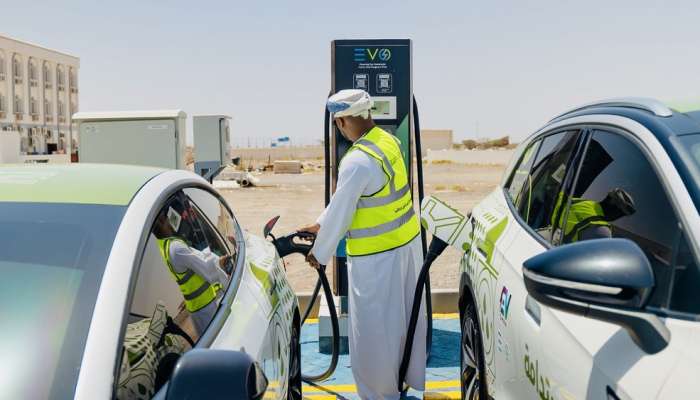
Muscat: Acting in coordination with the Authority for Public Services Regulation and Oman Net Zero Centre, the Ministry of Transport, Communications and Information Technology has announced the application of new electric vehicle (EV) charging fees, ranging from 50 to 120 Baisa per kilowatt-hour, depending on the charging capacity and speed, with effect from 1 October 2026.
According to the approved standard, the charging fee will be 50 Baisa per kilowatt-hour for chargers with a capacity of 90 kilowatts or less, 90 Baisa per kilowatt-hour for chargers with a capacity between 91 and 180 kilowatts and 120 Baisa per kilowatt-hour for chargers with a capacity of 181 kilowatts or more.
The application of these fees stems from steps to regulate the electric vehicle charging market in the Sultanate of Oman, enhance price transparency for electric vehicle owners/users and support the growth and sustainability of the electric vehicle charging infrastructure.
The fees were determined after a comprehensive study on the economic and operational aspects of electric vehicle charging stations. The study aimed to strike a balance between affordability for users and economic viability and investment sustainability for charging station operators.
The study took into account several factors related to the cost of establishing and operating stations, including the varying capital and operating costs and the speeds of the charging equipment, as well as station utilization rates and investment payback periods.
The findings of the study showed that the fees for charging electric vehicles at service stations remain lower in comparison to the cost of using gasoline-powered vehicles. This affirms the attractiveness of electric vehicles as a practical and economic option and supports the move towards expanding the use of more sustainable transport methods in the Sultanate of Oman.
To achieve a balanced pricing structure that considers consumer needs and encourages investment and expansion in electric vehicle charging infrastructure, several surveys were conducted among electric vehicle users, industry stakeholders and other interested parties. The surveys aimed to understand user expectations and their satisfaction with service fees, thus supporting community participation in decision-making.
The electric vehicle charging market in the Sultanate of Oman is undergoing a new phase of regulation and expansion. Currently, there are charging points operated by Shell Oman Marketing and First Electric Vehicle Company. Several new operators are in the stages of planning and feasibility study, which covers site evaluation, technical and operational assessments and coordination in terms of electrical grid connection and infrastructure requirements. The new operators will be announced upon their entry into the market and the start of the actual installation and operation.
The Ministry of Transport, Communications and Information Technology has developed a unified national platform for electric vehicle charging—the "Charger App", to serve as a single national interface. This platform allows electric vehicle users to access information on charging points operated by various providers across the Sultanate of Oman. It offers information about locations, the number of chargers, their operational status and availability, the charger types, the charging capacity, the operating hours and approved service fees.




