Sunday 30 / August / 2026
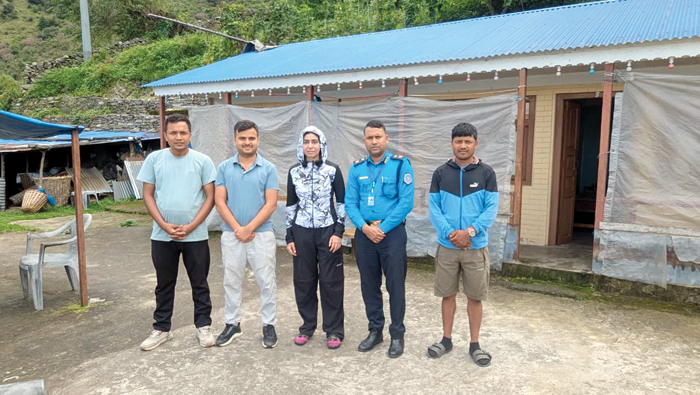
MUSCAT: Her love for trekking in the mountains may have saved 51-year-old Omani citizen Fathiya Al Zadjali from the devastating floods that swept through Nepal.
“If I hadn’t gone trekking to Yala Peak on 21 August, something bad would have happened to me,” Al Zadjali told Times of Oman, recounting the terrifying ordeal that left her stranded for three nights before she was rescued.
Al Zadjali was coming down from Yala Peak when she witnessed floodwaters and debris rushing through villages below.
“When I went to the top of Subra village after three hours of trekking, we saw the river eating up everything that was coming in its way. From the mountaintop, we could see that something was happening down in Subra. Then we panicked,” she said.
“We saw the area where our hotel was, the village and the people we had met — everything was gone.”
Soon afterwards, they received a warning telling them not to descend. “We got a call saying, ‘Please stay here, don’t go down. The situation is very bad,’” she said.
The group remained stranded at the top of the mountain, watching rescue helicopters operating in the area but unable to reach them.
“Normally, trekking down from the mountain takes only two or three hours. But we were stuck in the village. We could see the rescue operations and helicopters coming and going, but we were too far away and we were at the top,” she said.
No power, no communication
As the disaster unfolded, a group of Nepalese police officers from Kathmandu also became stranded in the same village. They had drones and had been trying to search for people affected by the disaster.
“They were also stuck because there was no electricity, no charging and all the bridges were broken,” Al Zadjali said.
“On the first day, the priority was naturally given to the people who really needed rescue. We were still fine. But the problem was that we could not contact anyone. It was very difficult to find a signal. There was no electricity, nothing,” she said.
Meanwhile, her family in Oman began contacting authorities after losing contact with her.
“My family started calling the police. Even some of my TikTok followers started sending messages to the government of Nepal asking about me,” she said.
The situation became even more confusing because Al Zadjali had originally been expected to be in the area a day earlier.
“There was one woman who was thought to have died. They didn’t know where she was or what had happened to her. I was supposed to be there that day, but I delayed my trip by one day. They thought I was gone,” she said.
“I believe this was what God had written for me. Something could have happened to me, but I was still there with the other people.”
Dramatic rescue
Her rescue finally came on the second or third day, when a helicopter arrived around noon.
“It was a small helicopter, but it was moving left and right because there was a village and farmland, and there was hardly any space to land. It was very dangerous,” she said.
“Finally, the helicopter managed to land somewhere, and we were rescued.” But the rescue did not take them directly to Kathmandu.
“People started asking me, ‘Are you from Oman?’ My name was already with the government. They gave me a microphone to speak to someone and asked, ‘Are you fine? Is everything OK?’ I said I was fine,” she said.
Nepalese army personnel then secured the group and asked if they needed food, water or shelter.
“I said no, I was fine. I just wanted to move from there because we were stuck,” she said.
She was then taken to a nearby army base. “All the army was there. Everybody was running. It was something like a war. It was unbelievable,” she said.
Army personnel recorded her details, including her name, country and age, and repeatedly asked if she needed food or water.
“They were helping people everywhere. I saw people rescuing others. The roads were blocked. Even some of the army personnel were injured. It was not easy to see, and it is not easy to explain. I will explain whatever I can,” she said.
After waiting for about 20 to 30 minutes, she was shifted by helicopter towards a location closer to Kathmandu.
“The first helicopter flight was about 10 minutes and the second was around 20 to 25 minutes. It was a big helicopter,” she said.
The helicopter was carrying not only Al Zadjali but also local Nepalese people, including elderly women. “We were all together,” she said.
‘I was safe’
The group eventually reached a military base camp, where Al Zadjali was examined by doctors.
“They asked my name, where I was from, my age and all that. There were doctors who came and spoke to me. They told me, ‘We know you are panicking. Take a breath,’” she said.
She was given water and biscuits. “I said I was fine and there was no risk,” she said.
The authorities then planned to take her to Kathmandu by helicopter, but Al Zadjali decided to travel by road instead.
“I said no, we were going to go by bus because we were already safe. We were not injured,” she said.
Asked when she plans to return to Oman, Al Zadjali said: “My tickets have not yet been booked, but hopefully it will be done soon.”
A love for the Himalayas
Despite the terrifying experience, Al Zadjali’s passion for Nepal’s mountains remains strong.
“This is not my first time going to Nepal. I’m a big fan of the Himalayas. I’m a trekker and mountain climber,” she said.
Her journey in Nepal began in 2019. “I have done 10 trips to Nepal since 2019. Whenever I have a chance, I just go to the mountains in Nepal,” she said.
But this trip was unlike anything she had experienced before. “What I saw this time was not a normal situation. If you see the situation with your own eyes, you are going to cry,” she said.
“I have never seen anything like this. Honestly, even a war did not feel like a normal situation to me.”
The emotional impact of the disaster continues to haunt her. “Until now, I am trying to recover because when you see people — nice people — suddenly everything is gone,” she said.
“I remember the lady who ran the shop where I bought my trekking sticks and shoes. Her shop is gone. And the man I bought chocolate from — I don’t know if he is alive.”
For Al Zadjali, the mountains that she has loved for years became the place where she witnessed unimaginable destruction — but also, ultimately, the place that kept her alive.