Monday 26 / October / 2026
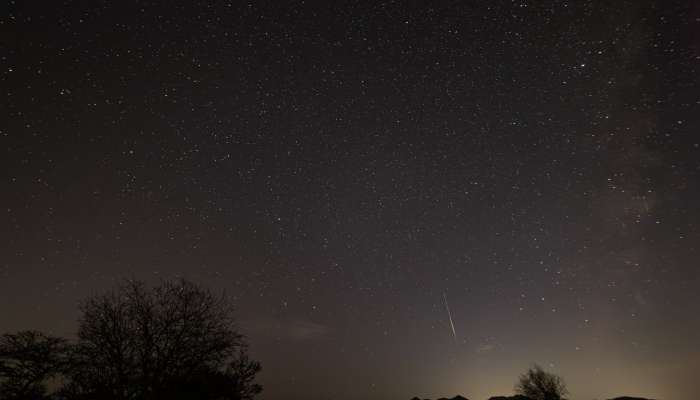
MUSCAT: Oman’s skies witnessed and documented 332 meteors from the annual Perseid meteor shower during its peak night, under favorable astronomical conditions coinciding with the new moon, which provided dark skies free from moonlight and enabled the observation of meteors over several hours.
Ibrahim bin Mohammed Al Mahrouqi, Vice Chairman of the Board of Directors of the Oman Astronomical Society, said the observation was conducted at a suitable location away from sources of light pollution, with the participation of seven people.
The observation began before the official documentation period, during which more than 35 meteors were recorded. Systematic documentation was then carried out from midnight until 4 a.m., during which 297 meteors were recorded.
The observations showed a gradual increase in meteor activity throughout the night. A total of 42 meteors were recorded between midnight and 1 a.m., rising to 62 between 1 and 2 a.m., and to 85 between 2 and 3 a.m. Activity peaked between 3 and 4 a.m., when 108 meteors were recorded.
Al Mahrouqi said the pattern was consistent with the favorable observing conditions after midnight and before dawn, when the Perseid radiant rises higher in the sky.
In a statement to the Oman News Agency (ONA), he said the documentation aims to study the Zenithal Hourly Rate (ZHR), an important indicator used to assess meteor-shower activity. Systematically collecting observations over several years can provide valuable information about the nature and distribution of dust and debris left by Comet Swift-Tuttle along its orbit around the Sun.
Comparing activity rates from one year to another can help determine the density and distribution of the debris and whether Earth has passed through particularly dense regions of the comet’s dust trail. Such observations can also contribute to developing models to predict years that could experience unusually strong meteor activity.
Al Mahrouqi explained that studying particles produced by the comet and analyzing their sizes and distribution can provide insights into how the comet’s nucleus breaks apart and changes over time. Such research is also relevant to understanding the nature of space debris and assessing its potential impact on satellites during periods of heightened meteor activity.
He noted that the elevation of the meteor shower’s radiant is an important factor affecting the number of visible meteors, alongside Earth’s direction of motion around the Sun. The side of Earth facing its direction of travel encounters a greater number of meteoroid particles, making the hours before dawn among the best periods for observing meteor showers.
Recording more than 100 meteors during the final hour of the observation reflected the favorable observing conditions and relatively dark skies, providing an indication of the strength of the shower during its peak night.
He added that determining the proportion of meteors belonging specifically to the Perseids also requires tracking their paths and linking them to the shower’s radiant. The absence of moonlight created particularly favorable conditions for observing faint meteors that can be difficult to see on moonlit nights, in addition to brighter meteors and fireballs.
Al Mahrouqi said the Oman Astronomical Society seeks through the initiative to move beyond astronomical observation toward systematic scientific documentation, including the recording, analysis and preservation of data in the Society’s archives. This will allow the observations to be compared with results from future years and used in astronomical studies and programs.
Such systematic documentation, he said, contributes to building an observational record of astronomical phenomena visible from Oman, strengthening the Sultanate of Oman’s presence in scientific astronomical observation and encouraging astronomy enthusiasts and researchers to participate in organized observations that can generate valuable long-term scientific data.