Monday 24 / August / 2026
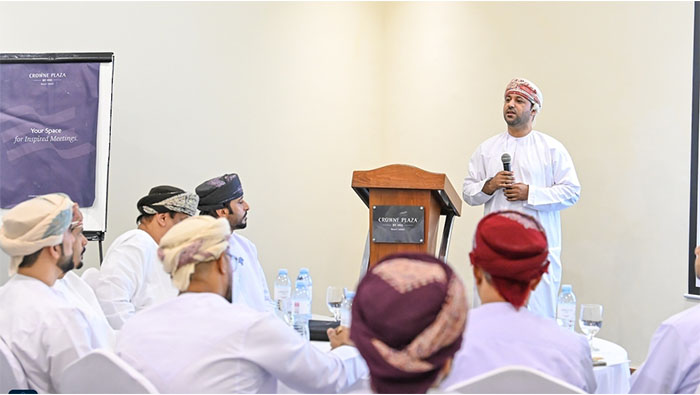
Salalah: The Ministry of Labour organised on Tuesday in the Wilayat of Salalah two laboratories: "Governance of Legislative Procedures and Ministerial Decisions" and "Arts, Entertainment, and Recreation Sector," as part of the activities of the third edition of the Labour Forum 2026.
A number of officials, specialists, and experts from the Ministry of Labour and other government units, alongside representatives from the private sector and relevant entities, are participating in the two laboratories.
Nasser Salim Al Hadhrami, Director General of the Directorate General of Labour in Dhofar Governorate, delivered a speech in which he emphasised the importance of governance in developing administrative and legislative procedures, and its role in enhancing transparency, simplifying procedures, raising decision quality, and achieving integration among various organisational units and partner entities, thereby contributing to providing a more stable and attractive work environment and achieving a balance between the rights and duties of the parties of production.
The two laboratories will continue over two days with the goal of reviewing several strategic files, anticipating challenges, and formulating practical, applicable solutions based on a participatory methodology that brings together experts, specialists, decision-makers, and representatives of government entities and the private sector.
The Governance of Legislative Procedures and Ministerial Decisions Laboratory focused on reviewing legislative and regulatory procedures related to the labor market, developing mechanisms for drafting ministerial decisions, raising the efficiency of the legal system, and enhancing governance and transparency principles, thereby contributing to simplifying procedures, accelerating completion, raising service quality, and achieving integration among relevant entities, which positively reflects on the business and investment environment.
The laboratory featured the presentation of a working paper titled "Regulatory Bylaw for the Labour System in Oil and Gas Field Areas," presented by Dawood Sulaiman Al Hinai, Director of the Legal Department at the Ministry of Labour. During the presentation, he reviewed the legal frameworks governing work in these areas, the most prominent challenges associated with implementing the bylaw, alongside several proposals aimed at developing regulatory procedures, enhancing compliance with legislation, and achieving a balance between economic development requirements and protecting the rights of the parties of production.
The laboratory also addressed the "Devolution" agreement, reviewing the legal and procedural aspects governing this type of agreement, implementation mechanisms, and their impact on regulating the transfer of obligations and rights among relevant entities, while discussing best practices that enhance legislative clarity and limit practical challenges.
On the other hand, the Arts, Entertainment, and Recreation Sector Laboratory discussed ways to develop the sector as one of the promising economic sectors by reviewing investment opportunities, analysing challenges facing its growth, and examining mechanisms to enhance its contribution to the gross domestic product (GDP), diversify income sources, and create sustainable job opportunities.
Huda Humaid Al Shibli, Director of Labour Market Studies, and Al Mirdas Hilal Al Ma'ani, Director of Statistics, presented a working paper addressing the sector's current reality, necessary foundations for its development, and the importance of building a regulatory and legislative framework supportive of investment and innovation, contributing to raising the sector's competitiveness and enhancing its presence in the national economy.
The proceedings of the two laboratories continued through panel discussions and specialised working groups, during which participants discussed key legislative, regulatory, and sectoral challenges, analysing their causes and effects before moving on to formulate solutions, initiatives, and recommendations according to a scientific methodology based on diagnosis, analysis, and foresight, ensuring the preparation of actionable outputs with a sustainable impact.
On the second day, the working groups are scheduled to present their outputs, discuss proposed recommendations, and evaluate their impact prior to adopting them as part of the labour market laboratories' outcomes, thereby contributing to developing the legislative system, enhancing procedure governance, supporting the growth of the arts, entertainment, and recreation sector, raising institutional performance efficiency, improving the business environment, and boosting labour market competitiveness.
These laboratories come as an extension of the Ministry of Labour's approach in adopting participatory working methods, engaging stakeholders in studying priority issues, and transforming challenges into development opportunities through institutional dialogue. This contributes to building more efficient and flexible policies and legislation and enhancing the contribution of new economic sectors to development, in line with the targets of Oman Vision 2040 and the next phase's requirements for modern legislation and regulatory procedures capable of keeping pace with economic, social, and technological transformations.
It is worth noting that the labor market laboratories are part of the activities of the Labour Forum 2026, organised by the Ministry of Labor under the slogan "A Nation's Vision: Empowerment and Action," which continues until 13 August.