Thursday 08 / October / 2026
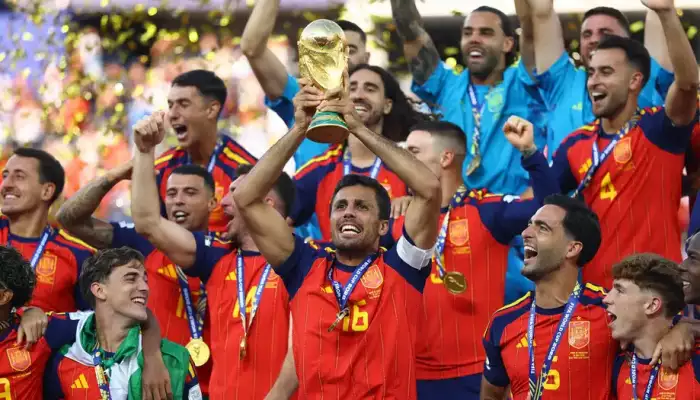
Patience proved the critical virtue for Spain. They had to wait for a kickoff delayed by — among other things — a Tom Cruise speech. They had to wait twice as long as usual at half time. And they had to wait for 106 minutes of play and their 20th shot before Ferran Torres lashed home the goal that would win them a second men's World Cup.
"I’m very moved. Looking back and thinking about them, we’ve won everything, absolutely everything, with this generation of players," said Spain coach Luis de la Fuente. "The match should have been decided much earlier ... but this is a World Cup final and you have to dig deep even against ten men, and we’re prepared for anything."
Spain's captain and player of the tournament, Rodri, lifted the trophy. But not before Donald Trump made his presence known. The US president was booed when he entered the pitch with FIFA president, Gianni Infantino and appeared keen to stay for the trophy lift, just as he had in the Club World Cup final last year. Rodri appeared to subtly attempt to usher Trump off the stage before Infantino jogged over to join Trump on the sidelines of the celebrations.
Messi on the margins
For much of Sunday’s final, that moment had felt purely a matter of time, as the European champions thoroughly outclassed their South American counterparts.
Just as they did in their impressive semifinal display against France, Spain dominated the ball early and their teenage superstar, Lamine Yamal, came close to opening the scoring in the fifth minute. Seconds later, at the other end of the pitch and the age scale, Lionel Messi was beaten to a through ball by Spanish keeper Unai Simon. It was as close as Messi, 39, got to a significant impact on the game, which may well be his last at a World Cup.
"They were better, to be honest," Messi said postmatch. “We lost the game, and we accept that. That doesn’t mean that we will forget everything we’ve done so far, so I’d like to thank my people, my players and the country."
As the first half wore on in the New York New Jersey stadium, Spain dominated the ball but Argentina held firm, with a smart Emi Martinez save from Spanish striker, Mikel Oyarzabal, as close as either side came before the elongated interval.
Half-time show keeps players waiting
For the first time in World Cup history, a Superbowl style half time show was on the cards. Performers including Madonna, Justin Bieber and BTS took to the pitch with the break extended — contrary to both football convention and FIFA laws — to almost double the standard 15 minutes.
It wasn’t enough to change the pattern of the game. Spain continued to pass, Argentina continued to scrap, hassle and rely on Martinez to keep Spanish shots at bay.
A red card for midfielder Enzo Fernandez in injury time made Argentina’s task even tougher as the final headed into extra time, as it now has in five of the last six finals. Argentina tired but somehow clung on, with Spain repeatedly wasteful.
Spain keep composure
Surely the South Americans, who had failed to take a single shot in the entire game, couldn’t somehow win this?
But Spain have already proved they won’t panic, with late winners in two of their knockout matches. Indeed, the final bore some resemblance to their tournament opener — a 0-0 draw with Cape Verde. After that, Spain slipped somewhat under the radar for a time, with a lack of cutting edge thought to count them out.
But as the tournament progressed, Luis de la Fuente’s team have delivered a masterclass in control while sharpening their attacking weapons to win a first World Cup since 2010. Spain’s women are also reigning world champions, winning the tournament in 2023.
"I think that in the end, the goal belonged to 47 million people, not to me or the 26 players here," said the goalscorer, Torres. "I believe that today destiny was written, it was meant for us to win, far from our fans, but we tried to make them feel as close as possible."
World Cup overshadowed by Iran war, Balogun controversy
The final ended a tournament that has offered much from a sporting perspective: the heroics of Cape Verde, the race between Messi and Kylian Mbappe for the tournament — and overall World Cup — top scorer and shocks such as Germany’s exit to Paraguay and Norway toppling Brazil.
But politics has also proved impossible to ignore.
The barring of Somali referee Omar Artan from entering the US added to the sense this was not a World Cup for the whole world. Iran’s treatment, being forced to fly in and out of games and given less preparation time as a result, was a reminder of the conflict between the US and Iran.
Donald Trump’s intervention in the suspension of a red card ban for US striker Folarin Balogun also amplified already loud questions about FIFA corruption.
But, ultimately, the tournament was decided in the same way it always has been. And, on Sunday in New Jersey it was settled, once again, in favor of Spain.