Sunday 31 / May / 2026
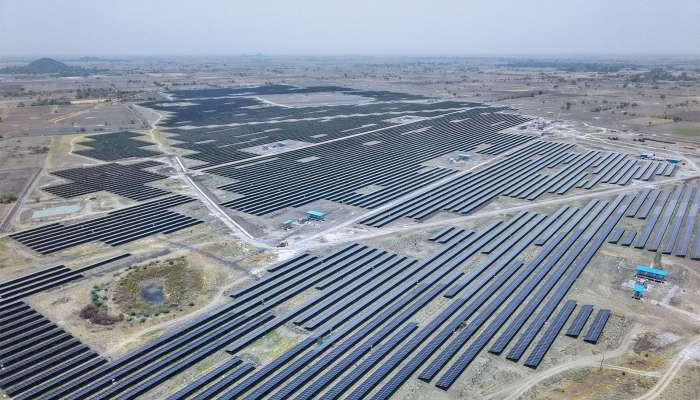
Thousands of solar panels are rapidly engulfing one of the world’s largest salt deserts. By 2029, nearly 60 million panels will cover 280 square miles of India’s Rann of Kutch, extending right up to the border with Pakistan. The Khavda solar park is set to be the world’s largest and most powerful supplier of electricity from the sun, with a generating capacity of 30 gigawatts — 30 times the size of a typical coal or nuclear power station and enough to power Austria.
With India’s economy now growing faster than China’s, Khavda epitomizes the country’s breakneck rush to electrify with solar power. Installed solar capacity in India has been growing by 40 percent a year. In March, it passed 150 gigawatts, and by 2030 is set to double again.
Analysts say the world’s most populous nation is on the verge of becoming the first major country to power its industrialization predominantly with solar energy.
Cheap solar is “enabling India to develop without the long fossil-fuel detour taken by the West and China,” said Kingsmill Bond, energy strategist and director at Ember, a U.K.-based think tank that tracks the world’s transition to renewable energy. “China built on coal; India is building on sun,” he said. “And what India is doing could also be mirrored in other emerging economies.”
India’s solar revolution comes as a surprise. Just a decade ago, apart from rooftop installations and a few microgrids serving remote rural villages, solar power was virtually unknown. The government seemed hell-bent on industrializing with coal, unleashing a rising tide of carbon dioxide emissions and supercharging climate change.
In 2015, shortly after taking office, Prime Minister Narendra Modi promised to double coal output by 2020. And at successive international climate negotiations, his ministers pushed back angrily against demands that the country renounce the fossil fuels that drove industrialization in Europe and North America.
“How can anyone expect that developing countries make promises about phasing out coal [when they] still have to deal with poverty reduction?” Environment Minister Bhupender Yadav asked angrily at COP26 in Glasgow five years ago, before sabotaging the conference’s planned declaration on eliminating coal from the global economy.
But back home, policy was already changing. The country’s sunny climate made it a natural home for solar energy, and the cost of solar panels was falling fast. Ever since the Glasgow conference, India has been introducing solar energy at an accelerating rate. Last year, for the first time, more than half its installed generating capacity was from non-fossil fuel sources.
As booming India’s electricity demand continues to grow by more than 6 percent each year, the solar trend is set to continue. According to the International Energy Agency, or IEA, about half the growth anticipated between now and 2030 will be met by solar power, and another 25 percent from other low-carbon sources, mostly wind, hydroelectric, and nuclear.
Leading the solar surge is the country’s largest private power producer and the world’s second largest solar developer, the Adani Group. Founded in 1988 initially as a commodity importer by Gautam Adani, a long-time confidante of Prime Minister Modi and reputedly now Asia’s richest person, it is widely regarded as having benefited from Modi’s patronage.
Eyebrows were raised in 2023 when long-standing military protocols banning all construction within 6 miles of the border with Pakistan were set aside weeks before Adani gained control of that land for the Khavda project. And in 2024, the U.S. Department of Justice accused Adani executives of paying hundreds of millions of dollars in bribes to Indian government officials to obtain lucrative supply contracts for its solar energy and hiding this from potential investors. The case was dropped this month after Adani made offers to invest in the U.S., though U.S. officials denied any link.
Still, the fast-growing Khavda solar park, which had an installed capacity of 9.4 gigawatts as of April, is the jewel in the Adani crown. Its panels are attended by robots that dry-clean them at night to remove desert salt and dust without requiring precious freshwater. The project also includes wind turbines in the windy coastal region on the shores of the Arabian Sea, which should secure nighttime power for the grid.
India still has a long way to go to break its dependence on fossil fuels. Coal still delivers most of the country’s baseload and fuels about 70 percent of total power generation. It helps make India the world’s third-largest carbon dioxide emitter, after China and the U.S, and is a major cause of the country’s urban smogs, which are the worst in the world. But the target to double coal mining output has been quietly forgotten, and construction of coal-fired power stations has been much reduced. Coal’s share in the energy mix is set to fall below 50 percent by 2035, according to the IEA.
Still, with its enormous generating capacity, coal remains deeply entrenched. And there are other constraints on how much solar power can contribute to keeping the lights on in India. While solar last year made up 28 percent of the country’s total installed electricity-generating capacity, it accounted for only 9.4 percent of the electricity put into supply.
Why the difference? There are two reasons.
The first is that the country’s outdated grid cannot yet transmit all the solar power being captured in the deserts of western India to where it is needed in the urban heartlands. At times last year, almost 40 percent of the country’s solar power output did not reach customers.
Charith Konda, an India-based energy researcher for the Institute for Energy Economics and Financial Analysis, attributes this to the rapid growth of solar facilities, which has outstripped grid development. “Solar plants typically take 18 to 24 months to build, while transmission projects usually take about five years… The grid is trying to catch up.” To that end, the Ministry of New and Renewable Energy has committed to spending more than $100 billion on expanding the national grid by 29 percent by 2032, through a series of green energy corridors linking solar hubs to major industrial and population centers.
But a revamped grid is only part of the answer, said Debajit Palit, who researches the country’s energy transition at the Chintan Research Foundation in New Delhi. Solar also underdelivers because India lacks the infrastructure to store renewable energy to meet demand after the sun goes down and during the cloudier monsoon season.
One solution being hurriedly adopted is to use water as a battery — so-called pumped storage. This involves linking two storage tanks or reservoirs, one higher than the other. When the grid has surplus power, that electricity is used to pump water from the bottom tank to the top tank. Then, when the grid needs extra power, it can be generated by dropping the water through turbines to the lower tank.
Starting later this year, a 1.4-gigawatt project is expected to pump water from one of India’s largest hydroelectric reservoirs, the Gandhi Sagar on the Chambal River in the state of Madhya Pradesh. Another, with a capacity of 3 gigawatts, is set for completion near Mumbai in 2030. In January, the country’s Central Electricity Authority identified 120 potential pumped-storage sites with a combined capacity of 180 gigawatts.
Another solution to the storage problem is lithium-ion batteries. World battery prices are falling dramatically — down 58 percent since 2023, said Ember’s global electricity analyst Kostantsa Rangelova, “making round-the-clock solar electricity increasingly viable.”
Recognizing this, the Indian government has since last year required new solar farms to install battery storage so they can supply more constant power to the grid. Adani is currently assembling the country’s biggest battery storage system at the Khavda complex — enough to discharge over a gigawatt of power to the grid for three hours every evening.