Sunday 08 / February / 2026
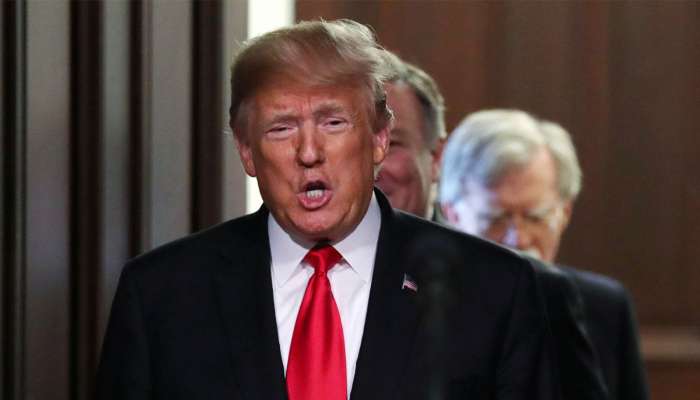
Washington DC: US President Donald Trump has confirmed that Washington and Tehran will hold further talks following what he described as "very good" initial discussions in Oman, even as Iran reiterated it would not agree to completely halt uranium enrichment, CNN reported.
The talks, held on Friday in the Gulf Arab state of Oman, marked the first round of negotiations between the two sides since the United States and Israel struck Iran last summer. Delegations from both countries participated in indirect discussions mediated by Oman.
"Iran looks like it wants to make a deal very badly. We have to see what that deal is," Trump told reporters on Friday. Speaking aboard Air Force One, he said another round of talks would take place "early next week," though Iranian Foreign Minister Abbas Araghchi later said no date had yet been set.
According to CNN, both sides agreed in principle to continue discussions after consulting their respective capitals.
The negotiations came amid heightened tensions, including a US military buildup in the Middle East and repeated warnings by Trump that Washington could strike Iran if it refused to sign a nuclear deal or used lethal force against protesters.
Ahead of the talks, Araghchi said Iran was entering diplomacy "with open eyes and a steady memory of the past year," while after the meeting he described the discussions as a "good start."
However, sharp rhetoric persisted on both sides. Trump said earlier this week that Iran's Supreme Leader Ayatollah Ali Khamenei "should be very worried," while Araghchi warned that Iran would target US bases in the region if Washington carried out threats against the Islamic Republic.
Despite describing the talks as productive, Trump said on Friday that a "big fleet" was heading toward Iran and would arrive soon, CNN reported.
The talks involved Araghchi and US envoy Steve Witkoff, with Trump's son-in-law Jared Kushner also participating. While the negotiations were formally indirect, Araghchi told Al Jazeera that he had direct contact with the US delegation and that the two sides exchanged a handshake. Omani Foreign Minister Badr Albusaidi acted as mediator.
Iranian media said the negotiations were meant to follow a format similar to earlier rounds of talks held before the 12-day Iran-Israel war in June, when Omani mediators shuttled between the two sides. Those talks collapsed after Israeli strikes on Iranian nuclear and military facilities, followed by US strikes on three Iranian nuclear sites.
According to CNN, the Israeli government has said Prime Minister Benjamin Netanyahu is expected to meet Trump in Washington next week to discuss the Iran negotiations. Netanyahu has insisted that any agreement must include limits on Iran's ballistic missile programme and an end to its support for regional proxy groups.
Iran, however, has said that discussions were strictly limited to its nuclear programme. Araghchi told Al Jazeera that no talks were held on ballistic missiles or regional proxies.
"We are prepared to reach an agreement that assures them that enrichment in Iran will be peaceful," Araghchi said, while stressing that Tehran would not accept a complete halt to enrichment.
Iran has offered to accept monitoring and checks to ensure its nuclear programme is not weaponised, in exchange for the lifting of US sanctions. Washington and its allies have rejected Iran's insistence on continuing enrichment, viewing it as a potential pathway to developing nuclear weapons.
Following the talks, the US announced new sanctions on Iranian oil and 14 vessels carrying it, signalling continued economic pressure.
"Instead of investing in the welfare of its own people and crumbling infrastructure, the Iranian regime continues to fund destabilising activities around the world," State Department deputy spokesperson Tommy Pigott said, as quoted by CNN.
The stakes remain high as the US continues to move military assets, including the USS Abraham Lincoln carrier strike group, closer to the region. Trump has previously said an "armada" was moving toward Iran "just in case."
Regional countries have been pushing for de-escalation, fearing that a new conflict would destabilise the Middle East and disrupt global energy markets. Iran has warned that any US or Israeli attack would be met with a far stronger response than in previous confrontations, including possible strikes on US bases and disruption of shipping through the Strait of Hormuz, a key artery for global oil and gas supplies, CNN reported.